

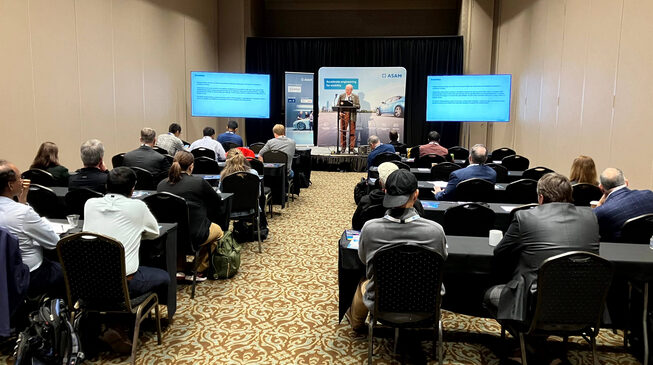
On October 23 at the Suburban Collection Showplace Novi, Michigan, standards organization ASAM gathered members and non-members from across the automotive ecosystem for its Regional Meeting North America 2025 to address the challenge of building safe, scalable and cost-effective autonomous driving technology
Set against a backdrop of accelerated AI-driven development, automation and simulation in the USA, ASAM’s meeting reflected how global standards are adjusting to regional needs. The emphasis was on shared data formats, languages, data models and interfaces for AI-based testing and validation methods, integrating simulation workflows across tools and domains, software-defined vehicles (SDV), diagnostics and OTA updates.
For the first time, the one-day regional meeting held training sessions on ASAM standard implementations for service-oriented vehicle diagnostics (ASAM SOVD) and ASAM OpenX standards for virtual development and validation. Alongside this, OEMs and tool suppliers shared real-world use cases on how standardization can help businesses. ASAM also discussed projects in 2025 and beyond. Speakers included General Motors, AVL, Deepen AI and Sibros, among others.
Setting the scene
Armin Rupalla, ASAM board member, opened the meeting by detailing the ICE and BEV powertrain revival and acceleration of AI and AVs. He discussed ASAM’s support of regulation fulfilment and the organization’s SDV-related activities, including virtual twin experience and real-world evidence such as test drives, safety and security compliance.
Trainings – ASAM SOVD
While Dr Philipp Rosenberger, CEO, Persival, presented a deep dive into ASAM’s OpenX simulation standards, Aneesh Bhir, group product manager, Sibros, and Bernd Wenzel, senior technical consultant at ASAM, discussed a new approach to automotive diagnostics and vehicle data access, ‘ASAM SOVD – Diagnostic API for software-defined vehicles’.
Wenzel introduced a SOVD training workshop. “It [SOVD] can support next-generation software architectures through uniform diagnostics of HPCs and continuous updates with new configurations. The vehicle as an ‘IOT device’ can analyze software during operation and support interactive diagnostics,” he said.
According to Wenzel, use scenarios beyond diagnostics include service-defined data access for fleet management, predictive maintenance and consumer applications. “There are consistent capability descriptions with identical offline and online formats, based on OpenAPI,” he said. “SOVD-to-service also allows access to commercial and agricultural vehicles, not just passenger vehicles.”
Wenzel and Bhir shared how Open Test Sequence eXchange format (OTX) and ASAM SOVD work together. “First published by ISO and extended by ASAM beyond traditional vehicle diagnostics, OTX is a domain-specific programming language (DSL) to describe test logic, ensuring it is executed on any system at any time,” Bihr explained. “The ASAM OTX extension SOVD executes diagnostic operations via ASAM SOVD API, based on JSON extension. There is no automotive-specific stack on the client-side, and there is support through all lifecycle phases. ASAM SOVD gives access to legal diagnostics by enabling tagging of entities and resources ahead of 2026 requirements.”
He revealed that ASAM SOVD is being transferred to ISO next year for adoption in future international regulations. Whereas ISO focuses on extended vehicle and web interface, ASAM addresses SOVD API and is not restricted to ISO 17978-2 use cases. November 2025 was the kick-off for ASAM SOVD 1.2.0, with a release in March 2028.
Testing
Wenzel then presented the ASAM TestSpecification project, showing how users can go from efficient testing to successful validation. “With SDVs and autonomous driving functions increasing testing complexity, collaborative efforts must focus on efficient development and test case execution,” he said.
Analyzing scenario-based testing workflows, Wenzel said interoperability is missing between established industry standards, with there being no standardized approach. He recommended harmonization, including the ASAM XIL generic simulator interface that connects test automation tools and enables test case reuse across systems.
Richard Romano, staff researcher – vehicle systems at GM, then explored the role of driving simulators and human-centered vehicle design; while Brunilda Caushi, strategy business development, AWS, shared insights on agentic AI for faster, better embedded development and testing.
Validation
Following this, Joshua Orlando, a project engineer at AVL, gave a presentation titled ‘From road to simulation’, focusing on data-driven testing and validation, and Mohammad Musa, CEO and founder of Deepen AI, spoke on ‘Sensor calibration – a new idea for a PTI-related ASAM standardization’.
Musa argued that there is no unified approach to calibration across OEMs, suppliers and service centers. “A lack of industry standards for validating calibration quality risks poor health insight throughout vehicle lifecycles and inconsistent measurements across modalities: lidar, camera, radar and IMU,” he warned.
To establish industry-wide calibration standards and ensure safety and consistency for ADAS/AV systems, Musa proposed different foundational alignment phases, contextual calibration and lifecycle integration.
Rachael Ayotte, business development manager at Vector Informatik USA, then shared how Vector realized SDV diagnostics through SOVD, both through in-vehicle software, which can communicate with the cloud and proximity server, and hardware tools. She said the vehicle becomes one REST server, using modern protocols HTTPS and OpenAI, with data exchanged physically via JSON.
Following Ayotte’s presentation, Mark Singer, director of marketing at Excelfore Corporation (a founding member of the eSync Alliance, which aims to standardize cloud-to-edge connectivity), highlighted how different approaches from OEMs, Tier 1s and software and cloud vendors risk innovation paralysis. To combat this, he shared the Hero MotoCorp connected vehicle platform, an OEM-first implementation of eSync OTA integrated with ASAM SOVD remote diagnostics and repair. Initial results have showed operational efficiency, enhanced driver experience, improved safety and security compliance.
With software affecting ride quality, cabin acoustics, lighting, smart HVAC and infotainment, and with customer expectations of technological innovation and digital life continuity, Omkar Karve, senior application engineer ADAS at MathWorks, proposed creating strategic customer value with rapid and robust development via collaboration through standards.
The future of ASAM standards
ASAM CEO Marius Dupuis concluded proceedings with a discussion of the organization’s active and planned projects. “Trends and activities include SDV/diagnostics, data for AI, driver monitoring systems, beyond automotive, simulation quality and global cooperation, such as with our Korea meeting in November, he said. “We have development partnerships with IEEE, ISO and SAE; research projects with AVEAS and projects with eSync Alliance.”
Musa added that Deepen AI is working on ASAM OpenX standards in off-road applications, led by University of Mississippi professor Daniel Carruth, eSync Alliance and open-source AD stack specialist Autoware (owned by L4 Japanese company Tier IV). Deepen AI is developing a data platform with Autoware and ASAM next year for DevOps.
The meeting was sponsored by Sibros and AVL alongside media partners Automotive Testing Technology International and ADAS & Autonomous Vehicle International. It was co-located with Automotive Testing Expo North America, where ASAM was a speaker, VIP sponsor and association partner.
Visit ASAM’s website for more information.
EXPLORE: Q&A – AI-enabled test optimization with Nissan and Monolith