

A new software platform is said to mark a step change in the digital twin arena. According to Finnish company Donut Lab, its DonutOS technology – which links digital modeling with real vehicle behavior – fundamentally changes how electric vehicles are conceived, engineered and brought to life. The company has coined this new approach Digital Twin 2.0.
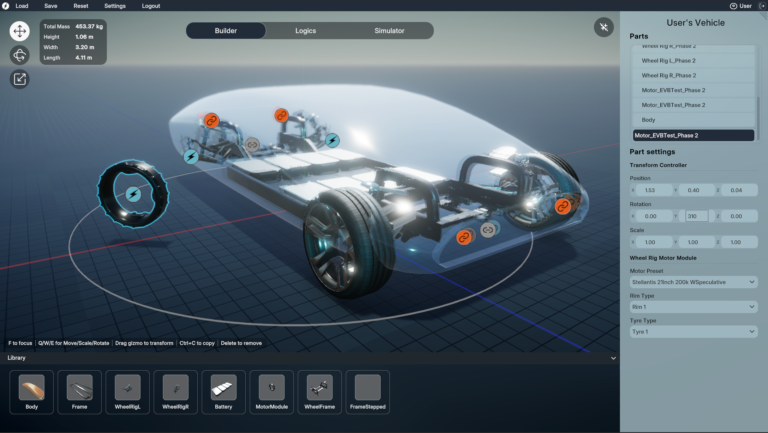
DonutOS brings the full workflow into one environment – design, simulation and validation – before hardware exists. Mechanical, electrical, behavioral, sensor and UI systems can be developed and evolved together. Where the majority of digital twins model only components or systems, Digital Twin 2.0 provides an interactive virtual vehicle that mirrors every system, sensor, control unit and data flow.
Donut Lab states that companies can test how an entire EV responds to real physics, conditions and sensor stimuli within DonutOS. They can observe full telemetry and data-bus activity exactly as it would occur in a production vehicle and they can also deploy the same software and logic to the physical vehicle once validated, ensuring continuity between digital intent and real-world performance.
Being able to do this compresses development cycles from years to months, or even weeks. It enables startups to forge vehicles with the sophistication of major OEMs without massive engineering teams. OEMs can reduce prototyping costs and validate vehicle behavior in conditions that would be impractical, or impossible, to replicate physically. Furthermore, software updates and new capabilities can be designed, tested and deployed across digital and physical fleets with consistency.
DonutOS is based around the Donut platform, which consists of a modular EV architecture and high-performance in-wheel motor technology.
As part of the launch of the software, Donut Lab has introduced the Global Innovators Program, giving selected EV companies early access to new technology, including DonutOS, along with tailored engineering support and preferential pricing at low volumes. General availability for DonutOS will be announced later.
The company’s CEO, Marko Lehtimäki, said, “DonutOS gives manufacturers the ability to design the entire vehicle – hardware, software and behavior – as a single digital organism. The goal is to help smaller mobility companies move faster, even when they don’t have the same resources as the big OEMs. Size shouldn’t count when it comes to innovation. With DonutOS we’re levelling the field and making advanced development approaches accessible.”
Learn about BMW’s digital twin initiative in the November 2025 issue of ATTI.
In related news, Software test specialists Solid Sands and Plum Hall team-up