

The digital key holds enormous potential – and a billion-dollar business opportunity. How do developers scrutinize a three-way ecosystem (vehicle-back end-mobile device) when each component is constantly evolving?
More and more OEMs are introducing the digital key as standard equipment. Whoever controls ‘the key’ also controls user data and customer relationships. However, with increasing adoption, pressure is mounting: the potential consequences of any malfunctions are enormous.
At the same time, the market remains highly complex. New vehicle and mobile device models are constantly entering the ecosystem – making interoperability the greatest technical challenge of the digital key, while ensuring both security and a consistent customer experience across all platforms.
CCC Plugfest: Reality check for the digital key
Major vehicle OEMs, mobile device manufacturers, hardware producers and software providers have recognized this and formed a globally unique industry consortium: the Car Connectivity Consortium (CCC). They have agreed on a unified standard for the digital vehicle key – the CCC Digital Key. This ensures a high degree of interoperability: interfaces are standardized to such an extent that complexity is significantly reduced.
The CCC specification defines standards for multiple hardware technologies, including NFC for convenience access, BLE for standard connectivity and UWB for precision positioning. The consortium offers certification pathways for these hardware implementations as well as for end-to-end use cases across the ecosystem.
The CCC standard is tested at so-called Plugfests, regularly hosted by consortium members. Here, the digital key implementations of OEMs are rigorously tested; new features and evolving standards are trialed and refined. These events also provide invaluable opportunities for industry exchange and mutual understanding of technical challenges. With the Plugfests now in their 15th edition, they have evolved into the industry’s most established real-world testing laboratories for digital vehicle access.
Inside the industry’s most comprehensive test laboratory
Last year’s European CCC Plugfest took place from November 10 to 14, in Friedrichshafen on Lake Constance in Germany. It was a week-long intensive testing environment with a focus on interoperability, new features and future hardware standards. What made this particular event noteworthy was that it was hosted by mid-sized software company doubleSlash, the first back-end provider ever to host a CCC Plugfest, underscoring the growing importance of back-end infrastructure in the digital key ecosystem.
“We have participated in five Plugfests over the past two years,” explained Manuel Teufel, product manager digital key at doubleSlash. “Hosting a Plugfest as a vehicle OEM server provider is quite unusual, but we really see the value in all sitting together and understanding the complex end-to-end chain.”
A successful Plugfest requires careful orchestration: confidential test spaces to protect pre-release technologies, short travel and communication paths between testing stations, and a tightly defined schedule. After 15 editions, the format has matured into a well-oiled process where all participants share the same objective – a productive test week that strengthens solutions for future customers.
Last year’s Plugfest highlighted the challenges currently faced by the digital key community. With vehicle platforms, mobile operating systems and hardware technologies evolving at different speeds, ensuring stable end-to-end interoperability has become increasingly complex. Beyond validating new features, the focus lay on improving system robustness, handling edge cases and validating non-functional requirements such as availability, performance and security under real-world conditions.
The back end as the invisible backbone of the digital key
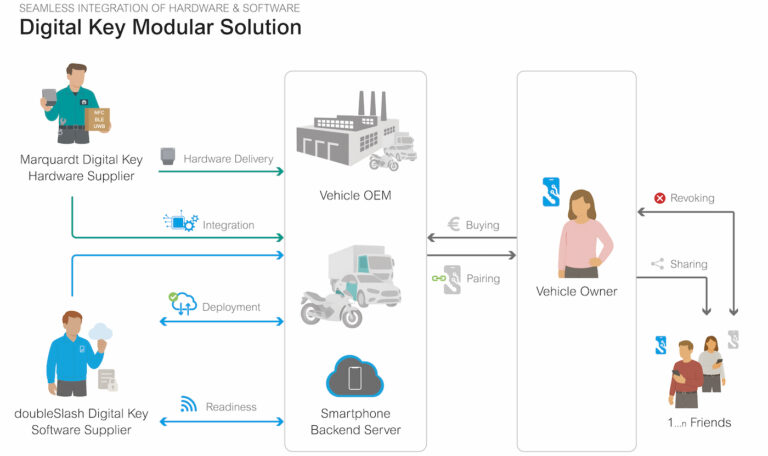
The core challenge of the digital key lies in connecting two complex and self-contained ecosystems: automotive and mobile communications. The back end links both worlds. It manages communication, security, access rights and key tracking. Without the back end, there is no interface – and without that, no interaction between vehicle and device.
Beyond pure functional correctness, the back end is also tested against non-functional requirements such as availability, system response times, disaster recovery scenarios and security stress tests – factors that ultimately determine whether a digital key solution is viable at scale. It was precisely these requirements that led doubleSlash to develop a white-label cloud solution years ago, long before the digital key became a mass-market feature.
The selection of a back-end provider as Plugfest host signals that the often-overlooked infrastructure layer can determine whether OEM implementations pass or fail interoperability requirements – while also enabling thorough end-to-end testing and rapid issue analysis across the entire digital keychain.
Validating a three-way ecosystem
One of the main challenges at the Plugfest is how to validate a three-way ecosystem – vehicle, back end and mobile device – when all three components are continuously evolving?
When the global automotive elite met tech giants at Lake Constance, OEMs tested vehicles both indoors and outdoors, while device manufacturers rotated between vehicle cabins to validate digital key functions in direct interaction with existing smartphones or new models to come.
“Testing under such conditions is like acting as a real end customer journey while facing real potential issues – but with immediate bug fixes and improvements,” Teufel reported. “The atmosphere is very positive and productive for each participant.”
To complement live testing, doubleSlash has developed its own simulation environment that emulates smartphone and vehicle requests and is integrated into the CI/CD pipeline. “Our so-called ‘simulator’ is executed in each deployment to ensure that the back end runs as expected in an end-to-end solution,” Teufel explained.
The back end must not only handle standard cases correctly but also cope with functional edge cases – for instance, when the vehicle connection is unstable or when messages get stuck in the vehicle hardware. Detailed logging of every interaction enables fast debugging and continuous sequence optimization during testing.
The software behind tomorrow’s vehicle key
doubleSlash has been developing back-end systems for automotive OEMs for more than 25 years and has already implemented the digital key for several brands. The doubleSlash digital key solution follows an API-first, hardware-agnostic architecture – a direct response to the interoperability challenges observed at CCC Plugfests.
The solution supports OEM-specific infrastructures while meeting the non-functional requirements tested at Plugfests, including availability, performance and security. doubleSlash has submitted its vehicle OEM server for official CCC certification – a pioneering step that would make it the first certified solution of its kind, following multiple successful production deployments.