

Close Menu
Automotive Testing Technology International
  • News
    • A-H
      • ADAS & CAVs
      • Aerodynamics
      • Appointments, Partnerships, Investments & Acquisitions
      • Automotive Testing Expo
      • Batteries & Powertrain Testing
      • Component Testing
      • Safety and crash testing
      • Dynamometers
      • EMC & Electronics Testing
      • Emissions & Fuel Consumption
      • Facilities
      • Full-vehicle Testing
    • I-Z
      • Interiors & Infotainment Testing
      • Measurement Tools, Test Systems & Equipment
      • Motorsport
      • NVH & Acoustics
      • Proving Grounds
      • R&D
      • Sensors & Transducers
      • CAE, Simulation & Modeling
      • Software Engineering & SDVs
      • Tire Testing
  • Features
  • Online Magazines
    • November 2025
    • Crash Test Technology – 2025
    • September 2025
    • June 2025
    • March 2025
    • Crash Test Technology – 2024
    • November 2024
    • September 2024
    • June 2024
    • Crash Test Technology – 2023
    • Automotive Testing Technology
    • Subscribe to Automotive Testing
    • Crash Test Technology
    • Subscribe to Crash Test Technology
  • Opinion
  • Awards
    • About
    • What’s new and key dates
    • Eligibility and nomination
    • Get in touch
    • Judges
    • Winner interviews
  • Videos
  • Supplier Spotlight
  • Proving Grounds
  • Events
LinkedIn Facebook X (Twitter)
  • Automotive Interiors
  • Automotive Powertrain
  • ADAS & Autonomous Vehicle
  • Professional Motorsport
  • Tire Technology
  • Media Pack
LinkedIn
Subscribe
Automotive Testing Technology International
  • News
      • ADAS & CAVs
      • Aerodynamics
      • Appointments, Partnerships, Investments & Acquisitions
      • Automotive Testing Expo
      • Batteries & Powertrain Testing
      • Component Testing
      • Safety and crash testing
      • Dynamometers
      • EMC & Electronics Testing
      • Emissions & Fuel Consumption
      • Facilities
      • Full-vehicle Testing
      • Interiors & Infotainment Testing
      • Measurement Tools, Test Systems & Equipment
      • Motorsport
      • NVH & Acoustics
      • Proving Grounds
      • R&D
      • Sensors & Transducers
      • CAE, Simulation & Modeling
      • Software Engineering & SDVs
      • Tire Testing
  • Features
  • Online Magazines
    1. November 2025
    2. Crash Test Technology – 2025
    3. September 2025
    4. June 2025
    5. March 2025
    6. November 2024
    7. Crash Test Technology – 2024
    8. September 2024
    9. June 2024
    10. Automotive Testing Technology
    11. Subscribe to Automotive Testing
    12. Crash Test Technology
    13. Subscribe to Crash Test Technology
    Featured
    November 27, 2025

    In this Issue – November 2025

    Automotive Testing Technology By Web Team
    Recent

    In this Issue – November 2025

    November 27, 2025

    In this Issue – 2025

    October 7, 2025

    In this Issue – September 2025

    September 5, 2025
  • Opinion
  • Awards
    • About
    • What’s new and key dates
    • Eligibility and nomination
    • Get in touch
    • Judges
    • Winner interviews
    • ATTI Awards Forum
  • Videos
  • Supplier Spotlight
  • Proving Grounds
  • Events
LinkedIn
Subscribe
Automotive Testing Technology International
Features

Miniature microphone solves big NVH challenges

Jeffrey Dosch, R&D engineer, and Mark Valentino, product manager, PCB PiezotronicsBy Jeffrey Dosch, R&D engineer, and Mark Valentino, product manager, PCB PiezotronicsDecember 11, 20255 Mins Read
Share LinkedIn Twitter Facebook Email
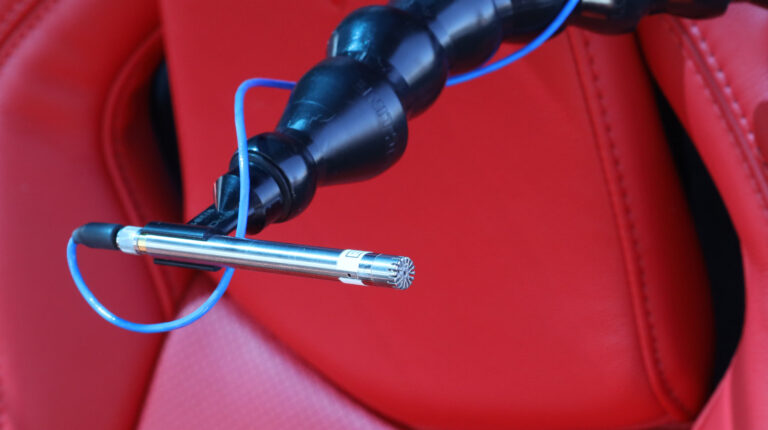
The new PCB model 378A08 microphone in a measurement application.

The PCB Model 378A08 is a compact ¼in free-field microphone engineered to be the quietest in its class, with a low noise floor of 22dB(A). Tests demonstrate that it delivers improved accuracy when measuring high-frequency tonal noise, making it particularly well suited for EV NVH applications

As electric vehicles remove the masking effect of an internal combustion engine, the cabin’s true acoustic signature becomes far more noticeable. Drivers suddenly hear it all: tire and aerodynamic noise, the hum of auxiliary systems, the rumble of drivetrain components, and the high-frequency tonal ‘whines’ produced by electric motors and inverters. These tones occur at very low sound pressure levels, yet they significantly affect overall sound quality. The shift raises a fundamental challenge for NVH testing engineers: how do you measure extremely low sound pressure level (SPL) at high frequencies without the microphone itself introducing distortion?

Selecting the right microphone typically involves weighing competing performance factors. Measuring low SPL demands high sensitivity and a very low noise floor – conditions traditionally met only by a ½in microphone. However, a microphone of that size introduces substantial diffraction errors at high frequencies. Diffraction, or interference in a sound field, becomes problematic when the microphone diameter approaches the wavelength of sound – a condition that occurs increasingly as frequency rises. These errors depend on the characteristics of the sound field, the size and orientation of the microphone and the frequency of interest. Even small deviations from the ideal alignment can cause significant measurement inaccuracies.

To minimize diffraction-related errors, microphones are engineered for specific sound fields: pressure, random incidence (diffuse) and free field. Each design aims to maintain constant sensitivity or a flat frequency response when the microphone is aligned correctly. For free-field microphones, this means pointing directly at the sound source in an environment free of reflections. When the microphone is oriented away from 0° incidence, sensitivity at high frequencies is reduced. This is where the physics becomes limiting for traditional NVH tools.

A ½in free-field microphone such as PCB model 378B02 is a highly dependable acoustic measurement sensor, with low-power ICP (integrated electronics piezo-electric [IEPE]) operation, excellent stability, a low noise floor and 50mV/Pa sensitivity. Its larger size, however, makes it susceptible to diffraction and orientation errors at higher frequencies. In an effort to reduce diffraction, engineers may opt for a smaller ¼in free-field microphone such as the PCB model 378C01. However, its higher 42dB(A) SPL typical noise floor and lower 2mV/Pa sensitivity limit its ability to capture the low-level tonal noise that EVs reveal so clearly.
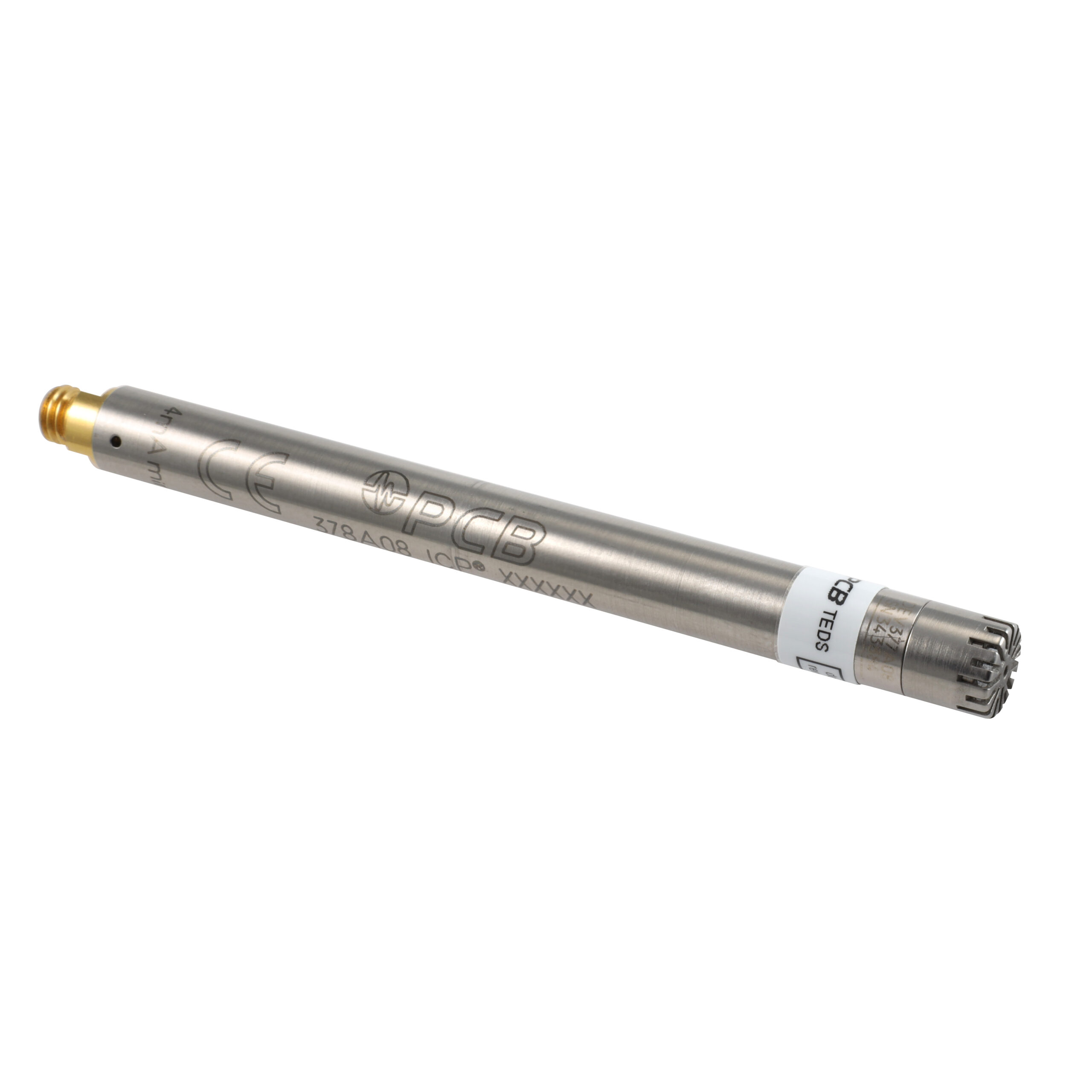
The newly developed PCB model 378A08 low-noise ¼-inch microphone  
The newly developed PCB model 378A08

This long-standing compromise between accuracy and noise performance is exactly what PCB’s new model 378A08 was developed to overcome. With a noise floor of just 22dB(A), it is the quietest ¼in measurement microphone in the world. Its compact size dramatically reduces diffraction errors, while its high sensitivity enables accurate capture of low SPL at high frequencies. The microphone also retains all the advantages of ICP technology, including low-power two-wire connectivity and the environmental stability that PCB microphones are known for.

The benefits of this design become clear when examining how ¼in and ½in microphones behave in different acoustic conditions. In Figure 1, the deviation of microphone sensitivity from its calibrated value is shown for several orientations. This deviation represents measurement error. Both microphone sizes exhibit some attenuation in sensitivity as frequency increases, depending on orientation, but the reduction is far more pronounced for the ½in microphone. The ¼in microphone maintains much more consistent sensitivity, making it a more reliable choice when the sound field or microphone direction cannot be perfectly controlled.

Figure 1: Graph showing the sensitivity difference from calibrated value (error), for free-field microphone when used in a free-field with orientations 0°, 90° and 120° to the field. Microphone is calibrated at 0° orientation and 120° is close to worst-case angle. The dashed lines indicate the sensitivity difference in a random incidence (RI) field.
Figure 1: Sensitivity difference from calibrated value (error), for free-field microphone when used in a free-field with orientations 0°, 90° and 120° to the field. Microphone is calibrated at 0° orientation and 120° is close to worst-case angle. The dashed lines indicate the sensitivity difference in a random incidence (RI) field

The noise floor behavior shows a similar pattern. A microphone’s free-field noise specification is published for 0° incidence, but in real applications, microphones often operate at different angles or in mixed field types. Larger microphones experience an increase in noise floor under these conditions due to diffraction. As shown in Figure 2, the small diameter of the 378A08 allows it to maintain a low noise floor even when oriented away from 0°. Remarkably, at 120° incidence and frequencies above 13.5kHz, its noise is actually lower than that of a ½in microphone.
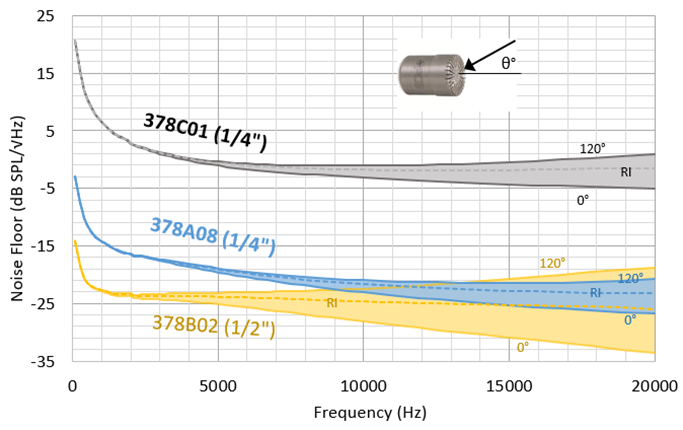
Figure 2: Graph showing the typical spectral noise floor for free field microphone in different orientations and fields. Shaded area depicts noise in a free field with orientations ranging from 0° to 120°. Dashed line is noise in an RI field.
Figure 2: Typical spectral noise floor for free-field microphone in different orientations and fields. Shaded area depicts noise in a free field with orientations ranging from 0° to 120°. Dashed line is noise in an RI field

Together, these results position the 378A08 as a practical solution for applications that require both reliable high-frequency accuracy and exceptionally low noise, particularly in the low-level tonal environments now common in EV NVH testing.


Share. Twitter LinkedIn Facebook Email
Previous ArticleCosworth launches SaaS version of Pi Toolbox
Jeffrey Dosch, R&D engineer, and Mark Valentino, product manager, PCB Piezotronics

Related Posts

Features

Q&A: Inside Smithers’ new test facilities in Suzhou, China

December 10, 20254 Mins Read
Measurement Tools, Test Systems & Equipment

VBox Automotive expands GNSS test equipment range

December 8, 20252 Mins Read
EMC & Electronics Testing

New PMx pulse load resistors developed by Isabellenhütte

December 8, 20253 Mins Read
Latest News

Miniature microphone solves big NVH challenges

December 11, 2025

Cosworth launches SaaS version of Pi Toolbox

December 11, 2025

Anritsu and Head Acoustics launch advanced voice quality testing solution

December 10, 2025
Free Weekly E-Newsletter

Receive breaking stories and features in your inbox each week, for free


Enter your email address:


Our Social Channels
  • LinkedIn
Getting in Touch
  • Free Weekly E-Newsletter
  • Meet the Editors
  • Contact Us
  • Media Pack
RELATED UKI TITLES
  • Automotive Interiors
  • Automotive Powertrain
  • ADAS & Autonomous Vehicle
  • Professional Motorsport
  • Tire Technology
  • Media Pack
© 2025 UKi Media & Events a division of UKIP Media & Events Ltd
  • Terms and Conditions
  • Privacy Policy
  • Cookie Policy
  • Notice & Takedown Policy
  • Site FAQs

Type above and press Enter to search. Press Esc to cancel.

We use cookies on our website to give you the most relevant experience by remembering your preferences and repeat visits. By clicking “Accept”, you consent to the use of ALL the cookies.
Cookie settingsACCEPT
Manage consent

Privacy Overview

This website uses cookies to improve your experience while you navigate through the website. Out of these, the cookies that are categorized as necessary are stored on your browser as they are essential for the working of basic functionalities of the website. We also use third-party cookies that help us analyze and understand how you use this website. These cookies will be stored in your browser only with your consent. You also have the option to opt-out of these cookies. But opting out of some of these cookies may affect your browsing experience.
Necessary
Always Enabled

Necessary cookies are absolutely essential for the website to function properly. These cookies ensure basic functionalities and security features of the website, anonymously.

CookieDurationDescription
cookielawinfo-checbox-analytics11 monthsThis cookie is set by GDPR Cookie Consent plugin. The cookie is used to store the user consent for the cookies in the category "Analytics".
cookielawinfo-checbox-functional11 monthsThe cookie is set by GDPR cookie consent to record the user consent for the cookies in the category "Functional".
cookielawinfo-checbox-others11 monthsThis cookie is set by GDPR Cookie Consent plugin. The cookie is used to store the user consent for the cookies in the category "Other.
cookielawinfo-checkbox-necessary11 monthsThis cookie is set by GDPR Cookie Consent plugin. The cookies is used to store the user consent for the cookies in the category "Necessary".
cookielawinfo-checkbox-performance11 monthsThis cookie is set by GDPR Cookie Consent plugin. The cookie is used to store the user consent for the cookies in the category "Performance".
viewed_cookie_policy11 monthsThe cookie is set by the GDPR Cookie Consent plugin and is used to store whether or not user has consented to the use of cookies. It does not store any personal data.

Functional

Functional cookies help to perform certain functionalities like sharing the content of the website on social media platforms, collect feedbacks, and other third-party features.

Performance

Performance cookies are used to understand and analyze the key performance indexes of the website which helps in delivering a better user experience for the visitors.

Analytics

Analytical cookies are used to understand how visitors interact with the website. These cookies help provide information on metrics the number of visitors, bounce rate, traffic source, etc.

Advertisement

Advertisement cookies are used to provide visitors with relevant ads and marketing campaigns. These cookies track visitors across websites and collect information to provide customized ads.

Others

Other uncategorized cookies are those that are being analyzed and have not been classified into a category as yet.

SAVE & ACCEPT