

ATTI recently visited Nexen Tire’s new home in Lapland for a rare chance to speak with its engineers about how the company is bringing its testing into the modern era
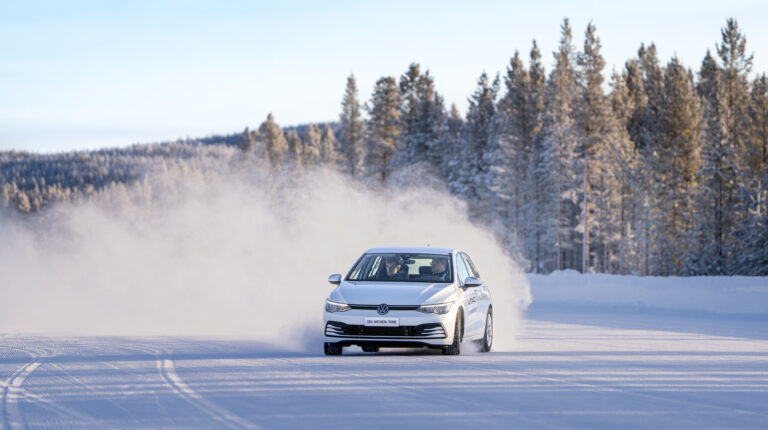
Adding to its worldwide R&D network, Nexen Tire has established a new European base at UTAC Ivalo to refine winter and all-weather products. Having been a customer for over two decades, the tire maker is no stranger to the winter testing grounds – and engineers now have their very own area on which to experiment. Construction began in April 2025, with the Purple Snow Ivalo Center, as it has been named, opening in December.
The European market accounts for more than 40% of the company’s total revenue, and with major European countries including Germany, Italy, Czech Republic and Sweden now requiring the use of certified winter tires with the 3PMSF marking during winter, this new asset is vital for Nexen. As part of its multi-pronged approach to strengthening winter tire development, it has also opened a laboratory to study the surface characteristics of roads in cold weather.
“We had been talking to car manufacturers for several years, saying that we needed this kind of facility, and finally the company agreed to it,” says Brad Kim, CTO of Nexen’s R&D Center in Korea.
The Purple Snow Ivalo Center features snow handling tracks with varying gradients and curves, including a 1,400 x 600m ride and handling circuit with an 18 m difference between the lowest and highest points; a track for testing the durability of studded tires; and a large straight of 700 x 40m. Upon completion, surface variation across all tracks was just 3cm – a result of which both Nexen and UTAC are incredibly proud.
Having this permanent base is a game-changer for Nexen, boosting testing capacity and the accuracy of results. Previously, with limited time to complete all tests, there was no room for flexibility, and if analyses needed to be repeated for correlation, it simply wasn’t possible. “If we were suspicious of the test results, but only scheduled to have the facility for a certain period of time, then there could be a long queue to test again,” explains Kim. “Now we can repeat a test as many times as we want until we are confident of the reliability [of the results].”
Out with the old, in with the new
Last August, the Korean auto industry’s first highly dynamic motion simulator began operating at Nexen’s tech center in Seoul, which will work in tandem with the Lapland base. This close connection between virtual and physical testing has become essential. Performance predictions can now be immediately cross-validated through on-snow driving tests, reducing the disparity between the real and digital worlds.
It’s no surprise that Kim’s team places a strong emphasis on virtual evaluation, aiming ultimately to need only one physical tire per program for validation. The Ansible Motion driving simulator is the starting point for transforming the company’s entire development process, which, Kim candidly told ATTI, is still largely done the traditional way. “We do virtual tire development pretty much the conventional way. We are currently judging whether we can integrate virtual testing methods into our conventional foundation phases.”

Kim describes this approach: “We build a tire and then test it. If we are not satisfied, we go back, adjust the compound or the construction, and then do more vehicle tests. Everything is well-established for virtual tire development, because we have many projects, so we just continue with the conventional approach.”
With one engineer often working on multiple projects at the same time – one product line may have as many as 140 sizes, and last year Nexen developed 600 additional sizes in the replacement market – it’s easy to see why the company has invested so substantially in new testing infrastructure. “In terms of productivity, I think we are top-notch – one engineer could be working on 10-20 different projects,” Kim proudly states.
“Some things you can estimate or judge on a single tire, like rolling resistance or spring constant. But what we need is to equip these tires on a specific vehicle, and we’re not there yet,” he adds. “We’re pushing in that direction; that’s why we installed the driving simulator. It’s about subjective feeling; it’s very difficult to objectively judge whether this tire fits this vehicle.”
It’s early days in Nexen Tire’s simulator journey, but the team is cracking on with getting up to speed and commissioning the system. “We’re in the middle of the conditioning stage, but at the same time we have started to do some tests with the machine. Our drivers should feel as if they are really driving, so we are tweaking the mechanics together with our simulator supplier. If there’s a way of tweaking parameters in the software, then we can do it.”
Another facet of the company’s digital analysis is the continued development of AI. Engineers have created a unique artificial intelligence tool, which they say has revolutionized analysis. For example, developers can input multiple parameters and have it predict rolling resistance. “The speed improvement is incredible. For a typical simulation, it could take about one day to give you the result; AI can take five minutes to get the same result, so it’s like a competition between simulation and AI.”
Working together, AI and simulation can be used to predict a tire’s footprint, for example.
Softly does it
Kim emphasizes that Nexen Tire does not limit its pool of suppliers and encourages proposals from potential new partners. It works with many of the major suppliers – Synthos, KKPC, LG Chem, Arlanxeo – as well some Japanese synthetic polymer suppliers.
He reveals that tire maker is currently “testing new concepts of compounds that remain flexible in low temperatures, with good handling and braking performance,” adding that it is also assessing novel construction concepts, especially in the replacement tire arena.
Middle man
Step by step, Nexen is performing correlation activities to refine the driving simulator, learning along the way. The engineers are clearly enjoying playing with their shiny new toy, but they’re not afraid to admit that they’re still getting to grips with it. “We need to learn from it. We know how to use it, but still the whole industry is in a learning phase,” comments vehicle dynamics expert Yannic Grassmuck.
In the replacement market, the sim could save a fortune, since changing a mold mid-project is not cost-effective. This is especially true in the winter tire segment, where molds are expensive and take longer to produce due to the sipes.
One of Grassmuck’s primary responsibilities is to translate OEM feedback for the engineers. Feedback is recorded in writing and then shared with the relevant team. Occasionally, joint tests are conducted with both Nexen and the OEM’s drivers, “which is very important because every OEM has small differences in the maneuvers that they drive, and the drivers need to be aligned on the expectations,” Grassmuck says.
According to Grassmuck, it’s common for an auto maker to allow three attempts at a virtual prototype, followed by only one or two real test loops.
The sticking point on every digital program remains the same as always: obtaining a vehicle model from the OEM. Companies have become more willing to provide these over the past year or two, says Grassmuck, but “it’s difficult. Some are willing to, some can officially provide [the model] but the internal process takes too long and it’s not very productive, so they give other options; there’s a workaround, let’s say.”
Who knows, maybe in the future Nexen Tire’s experts could have a smaller simulator in Europe, adds Grassmuck, but for now, they’re not getting ahead of themselves. It is a major financial investment, and they first need to maximize the potential of the simulator in Korea.
More on UTAC’s facilities in the November 2025 edition of ATTI