


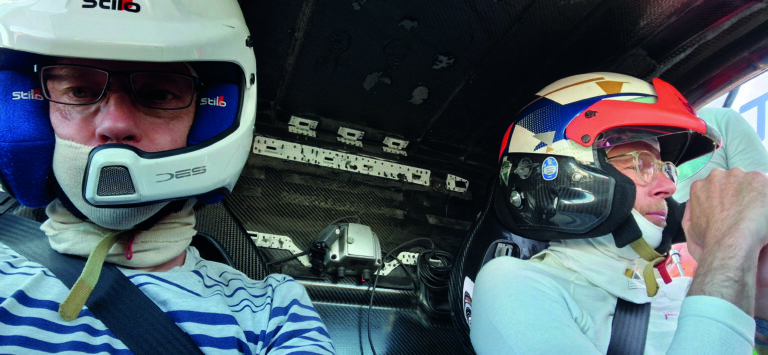
With next week’s Automotive Testing Expo Europe on the horizon, ATTI Awards jury member Damian Harty discusses the difficulties that face test engineers trying to stay on top of software complexity and evolving consumer behaviors
In 2010, Damian Harty was enjoying an especially rewarding time in his career as technical specialist in dynamics at Prodrive, the renowned UK engineering consultancy and motorsport preparation outfit. Having previously been involved in the development of the all-conquering Subaru Imprezas in the World Rally Championship, he had turned his attention to the new (and disappointingly short-lived) Mini Countryman WRC initiative. At that time, Harty wrote an article for Vehicle Dynamics International, ATTI’s former sister title, about the Mini’s development, in which he memorably noted, “There will always be a bigger rock. However much suspension travel there is, it will all get used up. Whatever loads are designed for, they will be exceeded.”
That there will always be a “bigger rock” neatly summarizes much of the difficulty of automotive testing, no matter which part of the vehicle is under consideration. Sixteen years later, during a chat with Harty, ATTI began by asking whether it is now easier than it was before to know where the limit of testing should lie. “I don’t think so, because the challenge is not so much about the vehicle itself, it’s about what the vehicle will encounter,” he replies. “And for as long as you have human drivers and, let’s say, imperfectly calibrated software drivers, it’s still difficult to anticipate the corner cases with which the vehicle will be presented.
“That was what I meant by ‘There will always be a bigger rock.’ So, the requirement to understand where we draw a line in the sand, and then what happens when we inevitably accidentally overshoot that line in the sand, still exists, I think.”
Harty notes that Sir Alec Issigonis, the designer of the original Mini, initially believed that the car’s combination of small size, light weight, front-wheel drive and hydrolastic suspension provided drivers with greater safety margins – but later realized that drivers would fully use up whatever margins you gave them.
“Someone will always go the other side of that line in the sand, so we still need to understand what happens there,” he continues. “We then try to make a value judgment about where we draw the line, such that, if you’re just below it then things emerge undamaged, or if you’re above it, things are damaged in a way that we can predict.
“A further difficulty is that you’re trying to stay inside the herd. If your line is drawn in more or less the same place as everyone else’s, then you’re probably okay. But if it is drawn a lot higher than everyone else’s, your products cost more than they need to; a lot lower than anyone else’s line and you will be on the receiving end of some pretty unpopular sentiment. I think that finding where to draw the line is no easier or more difficult than it ever was.”
A blend of human experience and previous data remains the key to determining how demanding a test should be, according to Harty. “One of the challenges that I understood very clearly in the powersports industry is that as your products improve, people move the line,” he observes. “The speed that people are willing to carry over a certain surface goes up, for example. As you make products better, people’s expectations increase. It’s not a static thing at all.” In short: the test engineer’s work is never done.

Recipe for success
Looking ahead to this year’s ATTI Awards, which will take place at Automotive Testing Expo Europe, Harty notes that test engineers are continuing to marry new techniques with established tools. For the latter, Isaac Newton’s F=ma remains his go-to for a back-to-basics understanding of what is happening to a vehicle, component or subassembly. He also expresses surprise at how little FEA has evolved in the past 30 years, computing power aside. For new methodologies, he highlights automotive software testing as an area where tools are advancing especially rapidly – but cautions that the industry’s understanding of how the product is being used, and therefore where the focus of testing should lie, is still evolving.
“Testing is about trying to find stuff before your customers do,” he explains. “The two areas where that’s most difficult tend to be durability and anything to do with software. The durability challenge is pretty much the same as it has always been. I think that for metallic components, we’re quite well served [with tools and knowledge]. But as soon as you switch to polymers or composites, for example, we’re grasping in the dark as to what they’ll do under repeated loading. That holds us back from using different materials for critical structural applications.
“Meanwhile, the scope for software is evolving all the time,” he continues. “When you put things in the hands of the public, you have the million-monkeys, million-typewriters problem, where they are generating scenarios that you maybe didn’t test for, so all the energy and effort is on the software side. Personally, I’m not so interested in whether the cellphone connectivity works properly or not, because it’s unlikely to be life threatening if you get that wrong. But there is a lot of functional stuff where many systems are interacting and there’s a whole load of corners to poke into. I feel like there is a lot of unmapped territory there that we’re still finding our way into as an industry.”
Harty believes that help in finding such corner cases will be one area in which AI will benefit the testing industry. “One of the things I like about AI is that it’s like talking to someone who isn’t necessarily all that clever but is hugely widely read. For the corner cases, I think it will be easier to poke more deeply into the corners, find and flag an issue, and specifically test for it.”
No two the same
Knowing what to test for will remain an issue for test engineers more generally, he believes, and will continue to be a moving target as customers exploit the margins to which Issigonis referred. Harty has been reminded of this in his recent work with TVS, India’s largest motorcycle manufacturer, rekindling a working relationship that began in the 1990s.
“For me, the biggest misconception about testing is the illusion that we really know what people are going to do with our products,” he confirms. “I think people underestimate how much of an honest best guess is used in all sorts of testing. There’s an erroneous belief in precision that’s misplaced when it comes to putting products out in the wild and understanding what people are going to do with them.
“When I began working with TVS in the 1990s, the engineers talked about how one product, a 50cc moped, was used as a load carrier. I did not understand what they meant: after all, it has a 50cc, two-stroke engine that makes just over one horsepower and can barely do 30mph [50km/h]! But when I came to India, I saw endless examples of multiple sheets of 8 x 4ft [2.4 x 1.2m] plywood, bags of concrete and more, all piled up in incredibly imaginative ways on mopeds with someone walking beside them, using the engine to just walk the load to where they wanted to go. I had no conception that the product could be used like that, but these engineers understood their market. The load case for the pedals was not a human, it was as many sheets of 8×4 ply as you could balance on it – a very different number of kilograms.
“That is an example of the sort of thinking that is quite difficult, especially if you’re coming up with a novel product,” he concludes. “It’s hard to imagine how people might conceive of using your product. That, I think, will continue to keep us interested and amused going forward.
“There is a glorious quote from Douglas Adams in Mostly Harmless: ‘A common mistake that people make when trying to design something completely foolproof is to underestimate the ingenuity of complete fools.’ He’s saying that whatever you think, there’s no guarantee that’s how everyone else will think. It’s a fascinating idea.”
This article was first published in the June 2026 edition of Automotive Testing Technology International
The results of this year’s Automotive Testing Technology International Awards will be announced at Automotive Testing Expo Europe next week – secure your ticket now!