

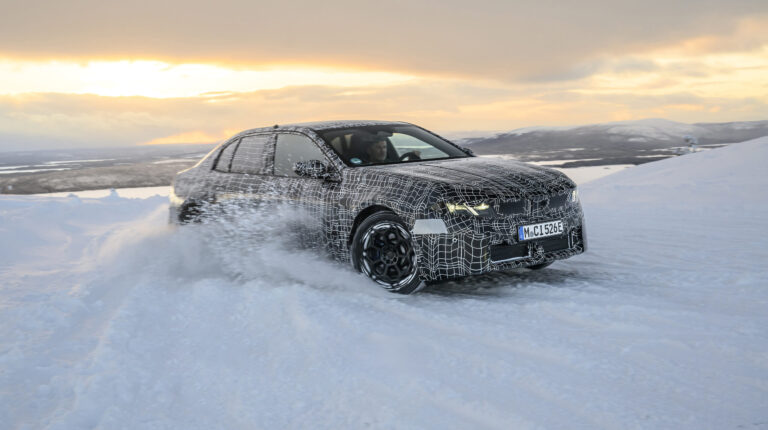
BMW is conducting final cold-weather testing of the fully electric BMW i3, the first sedan model in its Neue Klasse, ahead of the model’s launch. Prototypes are being tested at the BMW Group winter test center in Arjeplog, Sweden, on snow-covered roads and frozen lakes.
The BMW i3 is set for its design premiere on March 18, 2026, and features the company’s sixth-generation eDrive (Gen6). “The BMW i3 applies the sporty sedan’s typical characteristics to a completely new vehicle concept defined by the BMW 3 Series DNA,” said Mike Reichelt, head of Neue Klasse BMW. “At the same time, it pushes the conventional boundaries of electric mobility into new territory, thanks to the potential of our Neue Klasse.”
Cold-weather testing is a key stage in BMW’s development process. Endurance trials in Sweden’s extreme north enable engineers to evaluate drive and suspension systems under low-friction conditions that are difficult to replicate elsewhere. Electronic control systems, in particular, are tested for their responsiveness and precision, providing the foundation for BMW’s characteristic driving dynamics.
Central to the i3’s handling is the Heart of Joy, one of four computing units in the Neue Klasse. Paired with BMW Dynamic Performance Control software, it manages the powertrain, brakes, some steering functions and recuperation.
The Heart of Joy also enhances stability and agility. BMW notes that the i3’s dual electric motors enable lightning-fast processing of control commands, contributing to both a light-footed driving feel and comfort.
Safety and control have been emphasized throughout the testing program. The i3 requires fewer interventions from systems like DSC while maintaining smooth, precise cornering. The model’s Soft-Stop function has been designed to deliver the smoothest braking in BMW 3 Series history, minimizing jerks and noise, and energy recuperation has been optimized, even when cornering, without compromising stability.
Related news, Tire Industry Project releases End-of-Life Tire Toolkit 2.0 to support circularity