

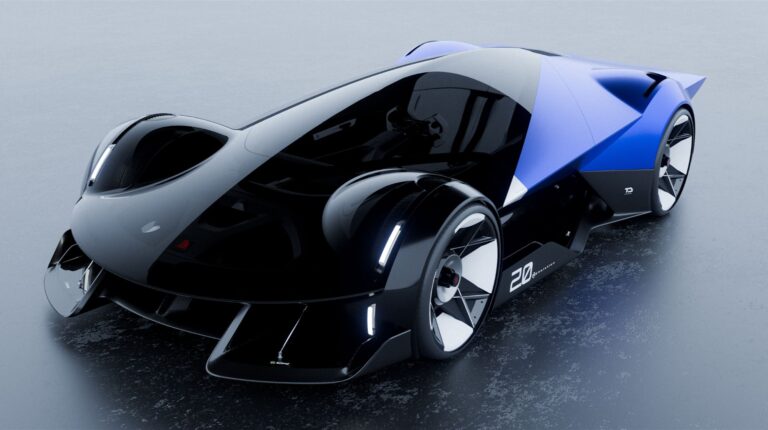
China Academy of Art (CAA) and its Institute of Transportation Design, in collaboration with Bcomp, have developed a new concept vehicle, Revelation, described as a driveable art–science integration concept car.
The project showcases Bcomp’s ampliTex natural-fiber composites, and brings together emerging Chinese automotive designers and advanced sustainable composite technologies.
The winning concept was penned by CAA master’s student Alisson Liu (Liu Diannan/刘殿南), whose design centers on sleek lines, state-of-the-art technology and carbon neutrality. It was subsequently developed into a full-size, driveable concept show car in China in partnership with Shanghai Tianjian Industrial Design.
Gabriele Grezzana, business development manager for APAC at Bcomp, said, “Alisson Liu’s striking new concept signals a bright future for Chinese automotive design and lower-carbon materials.”
From concept to reality
Design leadership came from CAA, with Tianjian providing critical technical and manufacturing execution. Tianjian’s core role was production fabrication and engineering realization. Leveraging its proprietary digital-twin review system and full-size adjustable review fixture, Tianjian enabled thorough vehicle-level validation throughout the design phase.
The project demonstrated a collaborative and replicable model for university–industry cooperation that could be adapted by Chinese art and design institutions in their respective contexts.
Emerging automotive designers in China are increasingly aware of environmentally conscious manufacturing and are open to using lower-carbon materials. Prof. James Hope, director of the CAA Institute of Transportation Design, commented, “By providing the opportunity to use these materials in a real-world, from-zero-to-one project, we have gained the experience and expertise to specify their use with confidence, opening direct pathways to OEM design teams and partner institutes in the future. Now, the next generation of Chinese design can take sustainability even further, utilizing lower-carbon materials and understanding how they can be used at scale in automotive production.”
Bcomp’s biocomposites
The CAA Institute of Transportation Design applied ampliTex extensively throughout Revelation, including in the front bumper, rear bumper, body side skirts, seats and wheel-cover hubs. This included exposed-fiber parts, with the weave visible beneath the clear coat.
For the exterior, the team selected ampliTex in gray; for the wheel hubs, ampliTex in charcoal was used, and the parts were overpainted in black. A high-gloss clear coat accentuated the composite’s weave and tone, delivering a modern automotive finish.

AmpliTex is woven from flax fibers, a renewable material that does not compete with food crops. Compared with other high-performance composites, such as carbon fiber, it reportedly reduces cradle-to-gate CO2 emissions by up to 85%. Once parts have reached the end of their service life, they can be used for thermal energy recovery, rather than being landfilled.
Liu said, “It has been an honor to see my concept, Revelation, come to life. My intention was to build upon fundamental principles of automotive design while embracing the electrified future and harnessing more sustainable materials. Bcomp is a pioneer and innovator in this area, taking sustainable composites from a niche technology to mainstream automotive production. We used ampliTex for many of the surfaces on Revelation, and the result is very impressive.”
In recent news, Kodiak AI announces autonomous trucking pilot in Canada