

Close Menu
Automotive Testing Technology InternationalAutomotive Testing Technology International
  • News
    • A-H
      • ADAS & CAVs
      • Aerodynamics
      • Appointments, Partnerships, Investments & Acquisitions
      • Automotive Testing Expo
      • Batteries & Powertrain Testing
      • Component Testing
      • Safety and crash testing
      • Dynamometers
      • EMC & Electronics Testing
      • Emissions & Fuel Consumption
      • Facilities
      • Full-vehicle Testing
    • I-Z
      • Interiors & Infotainment Testing
      • Measurement Tools, Test Systems & Equipment
      • Motorsport
      • NVH & Acoustics
      • Proving Grounds
      • R&D
      • Sensors & Transducers
      • CAE, Simulation & Modeling
      • Software Engineering & SDVs
      • Tire Testing
      • Webinar
  • Features
  • Online Magazines
    • June 2026
    • March 2026
    • November 2025
    • Crash Test Technology – 2025
    • September 2025
    • June 2025
    • Automotive Testing Technology
    • Subscribe to Automotive Testing
    • Crash Test Technology
    • Subscribe to Crash Test Technology
  • Opinion
  • Awards
    • About
    • Eligibility and nomination
    • Get in touch
    • Judges
    • Winner interviews
  • Videos
  • Directories
    • Supplier Spotlight
    • Proving Grounds
  • Webinar
  • Events
LinkedIn Facebook X (Twitter)
  • Automotive Interiors
  • Automotive Powertrain
  • ADAS & Autonomous Vehicle
  • Professional Motorsport
  • Tire Technology
  • Media Pack
LinkedIn
Subscribe
Automotive Testing Technology InternationalAutomotive Testing Technology International
  • News
      • ADAS & CAVs
      • Aerodynamics
      • Appointments, Partnerships, Investments & Acquisitions
      • Automotive Testing Expo
      • Batteries & Powertrain Testing
      • Component Testing
      • Safety and crash testing
      • Dynamometers
      • EMC & Electronics Testing
      • Emissions & Fuel Consumption
      • Facilities
      • Full-vehicle Testing
      • Interiors & Infotainment Testing
      • Measurement Tools, Test Systems & Equipment
      • Motorsport
      • NVH & Acoustics
      • Proving Grounds
      • R&D
      • Sensors & Transducers
      • CAE, Simulation & Modeling
      • Software Engineering & SDVs
      • Tire Testing
      • Webinar
  • Features
  • Online Magazines
    1. June 2026
    2. March 2026
    3. November 2025
    4. Crash Test Technology – 2025
    5. September 2025
    6. June 2025
    7. Automotive Testing Technology
    8. Subscribe to Automotive Testing
    9. Crash Test Technology
    10. Subscribe to Crash Test Technology
    Featured
    June 1, 2026

    In this Issue – June 2026

    Automotive Testing Technology By Web Team
    Recent

    In this Issue – June 2026

    June 1, 2026

    In this Issue – March 2026

    March 25, 2026

    In this Issue – November 2025

    November 27, 2025
  • Opinion
  • Awards
    • About
    • Get in touch
    • Judges
    • Winner interviews
    • ATTI Awards Forum
  • Directories
    • Supplier Spotlight
    • Proving Grounds
  • Webinar
  • Videos
  • Events
LinkedIn
Subscribe
Automotive Testing Technology InternationalAutomotive Testing Technology International
Features

Transforming temperature control in the automotive industry

Peter Huber KältemaschinenbauBy Peter Huber KältemaschinenbauJune 17, 20263 Mins Read
Share LinkedIn Twitter Facebook Email
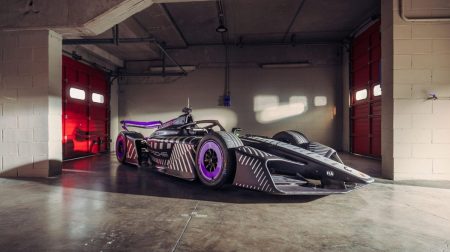
Firefly car with neon blue and red colors, and hot and cold dark background fire.

Temperature and flow control technology that uses CO2 as a refrigerant is an environmentally friendly alternative to synthetic refrigerants that is also abundant, safe and non-flammable

A key heat transfer fluid (HTF) in automotive applications is monoethylene glycol (MEG) mixed with water in varying ratios. At low temperatures this fluid becomes viscous. Peter Huber Kältemaschinenbau’s Unimotive range of temperature control units are specifically designed and built so that this increasing viscosity does not affect either the temperature control or the flow control. Testing encompasses safety evaluations including material flammability tests, stress and load analyses and temperature-dependent assessments. Huber’s temperature control systems, coupled with the accurate flow control of HTF, results in reliable and repeatable results. This not only enhances the overall quality and safety of automotive components but also ensures precise engineering outcomes for manufacturers.

Huber's Unimotive GL temperature control system.
The Unimotive range is specially designed for applications in the automotive industry and operates with water-glycol. Typical use cases include temperature simulations, material testing and temperature-dependent stress and load tests

Leading the green way

The automotive sector is a leader in technological innovation and progress. The sector is driving ever-improving efficiencies and implementing green energy solutions. Sustainability and energy conservation have been at the core of engineering design and execution at Huber since the company started in 1968. The company’s dedication to sustainability is reflected in its use of natural refrigerants in all models, with options including refrigeration systems that use CO2 as a refrigerant with set-points as low as -45°C. Products are fabricated using high-quality, recyclable materials that promote longevity and reduce waste. It is attention to details like this that Huber believes sets it apart and demonstrates the company’s commitment to sustainable manufacturing.

CO2-based automotive temperature control technology 

Its latest achievement in sustainable innovation, the Unimotive GL (Green Line) series, sets a new benchmark in environmentally friendly refrigeration, according to the company. Operating with CO2, this series provides a 100% eco-friendly alternative to systems using synthetic refrigerants. Designed specifically for automotive applications, the Unimotive GL series facilitates direct operation with water-glycol solutions, offering an extensive temperature range (in the XT variant) from -45°C to 150°C.

Attaining such an elevated temperature using water/MEG as an HTF is achieved by passively and safely pressurising the HTF circuit. In the event of a power failure, the pressure is safely lowered without the use of active components.
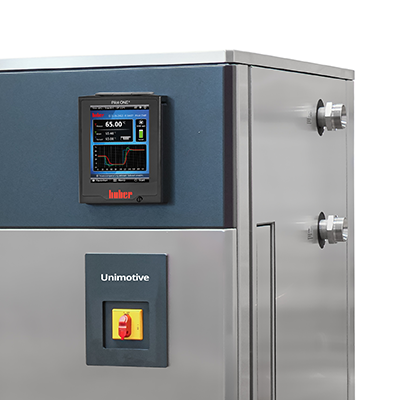
The Pilot One controller with touch screen and professional functions.
The Pilot One controller with touch screen and professional functions

The series supports diverse applications, including temperature simulation tests, material durability evaluations and stress/load testing for functional automotive components. Since its adoption in the refrigeration field in the 19th century, CO2 has proven to be highly effective. With no ozone depletion potential (ODP = 0) and a minimal global warming potential (GWP = 1), it significantly reduces environmental impact. Additionally, CO2’s large-scale natural availability eliminates energy-intensive production processes. Its non-flammable, non-toxic and chemically inert properties make it an ideal choice for sustainable engineering solutions.

For the XT variant, with temperatures reaching up to 150°C, the carbon footprint remains minimal across the lifecycle – from production to operation and beyond.

Progress and sustainability

As automotive manufacturers integrate these eco-friendly systems, they contribute to both technological progress and environmental preservation. Huber’s principles of quality, performance, reliability and repeatability are coupled seamlessly with ecological responsibility — which Huber says is a testament to the brand’s enduring legacy and forward-thinking ethos. In summary, Huber’s eco-friendly temperature control technology goes beyond machinery and metrics. It is a catalyst for reshaping the automotive landscape sustainably.


Share. Twitter LinkedIn Facebook Email
Previous ArticleAutomotive Testing Expo Europe 2026 opens next week with packed content program
Next Article Real-world EV test names Xpeng X9 top performer
Peter Huber Kältemaschinenbau

Related Posts

Damian Harty sits in a race car with a colleague, both wearing helmets.
Automotive Testing Expo

ATTI Awards panelist interview: Damian Harty

June 16, 20268 Mins Read
The TI battery monitor displaying information on a display screen on the dash of a vehicle driving through a cold, snowy environment.
Batteries & Powertrain Testing

Texas Instruments develops high-cell-count EIS-enabled intelligent battery monitor

June 10, 20263 Mins Read
ATTI editor Rachel Evans during an onstage interview with Partha Goswami, principal of PG Mobility in the Future of Automotive Testing Conference at Automotive Testing Expo North America 2025.
Automotive Testing Expo

ATTI Forum interview: Rachel Evans, editor of ATTI magazine

June 10, 20265 Mins Read
Latest News

Real-world EV test names Xpeng X9 top performer

June 18, 2026
Firefly car with neon blue and red colors, and hot and cold dark background fire.

Transforming temperature control in the automotive industry

June 17, 2026
Visitors intently listen in the ATTI Forum.

Automotive Testing Expo Europe 2026 opens next week with packed content program

June 17, 2026
Free Weekly E-Newsletter

Receive breaking stories and features in your inbox each week, for free


Enter your email address:


Our Social Channels
  • LinkedIn
Getting in Touch
  • Free Weekly E-Newsletter
  • Meet the Editors
  • Contact Us
  • Media Pack
RELATED UKI TITLES
  • Automotive Interiors
  • Automotive Powertrain
  • ADAS & Autonomous Vehicle
  • Professional Motorsport
  • Tire Technology
  • Media Pack
© 2025 UKi Media & Events a division of UKIP Media & Events Ltd
  • Terms and Conditions
  • Privacy Policy
  • Cookie Policy
  • Notice & Takedown Policy
  • Site FAQs

Type above and press Enter to search. Press Esc to cancel.

We use cookies on our website to give you the most relevant experience by remembering your preferences and repeat visits. By clicking “Accept”, you consent to the use of ALL the cookies.
Cookie settingsACCEPT
Manage consent

Privacy Overview

This website uses cookies to improve your experience while you navigate through the website. Out of these, the cookies that are categorized as necessary are stored on your browser as they are essential for the working of basic functionalities of the website. We also use third-party cookies that help us analyze and understand how you use this website. These cookies will be stored in your browser only with your consent. You also have the option to opt-out of these cookies. But opting out of some of these cookies may affect your browsing experience.
Necessary
Always Enabled
Necessary cookies are absolutely essential for the website to function properly. These cookies ensure basic functionalities and security features of the website, anonymously.
CookieDurationDescription
cookielawinfo-checbox-analytics11 monthsThis cookie is set by GDPR Cookie Consent plugin. The cookie is used to store the user consent for the cookies in the category "Analytics".
cookielawinfo-checbox-functional11 monthsThe cookie is set by GDPR cookie consent to record the user consent for the cookies in the category "Functional".
cookielawinfo-checbox-others11 monthsThis cookie is set by GDPR Cookie Consent plugin. The cookie is used to store the user consent for the cookies in the category "Other.
cookielawinfo-checkbox-necessary11 monthsThis cookie is set by GDPR Cookie Consent plugin. The cookies is used to store the user consent for the cookies in the category "Necessary".
cookielawinfo-checkbox-performance11 monthsThis cookie is set by GDPR Cookie Consent plugin. The cookie is used to store the user consent for the cookies in the category "Performance".
viewed_cookie_policy11 monthsThe cookie is set by the GDPR Cookie Consent plugin and is used to store whether or not user has consented to the use of cookies. It does not store any personal data.
SAVE & ACCEPT