

Graz University of Technology (TU Graz) has installed a Dynisma DMG-X driving simulator at its recently established Advanced Driving Simulation Center on the Inffeldgasse campus in Graz, Austria.
The DMG-X is a driver-in-the-loop (DIL) simulator developed for automotive OEM testing and development programs. The system is designed to support high-fidelity simulation for applications including ride comfort evaluation, and noise, vibration and harshness (NVH) testing.
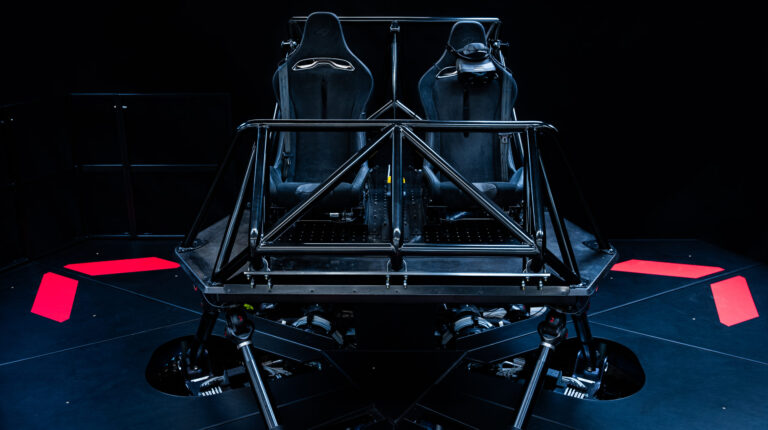
According to Dynisma, the simulator delivers motion bandwidth exceeding 100Hz across all six degrees of freedom with latency of 3-4ms. The platform also provides vertical excursions of up to 400mm and supports payloads of up to 750kg, enabling testing with full-scale vehicle prototypes.
These capabilities allow the simulator to replicate real-world driving conditions with high accuracy, supporting development work throughout the automotive lifecycle from early concept phases through to series production.
The Advanced Driving Simulation Center is intended to support studies that bridge theoretical vehicle modeling with human driver perception in simulated environments. It will use the DMG-X for research and development projects with international automotive manufacturers.
Research conducted at the center will focus on areas including vehicle dynamics, ride comfort, NVH behavior, human-machine interface (HMI), advanced driver assistance systems (ADAS) and autonomous driving technologies.
Graeme Cook, the CEO of Dynisma, said, ” This installation demonstrates the increasing recognition of high-fidelity simulation as an essential tool for automotive development, and creates an ideal environment to showcase the transformational benefits our DMG-X technology delivers – significantly reducing development time, costs and environmental impact while accelerating innovation across every key area of vehicle development.
“Early-stage DIL simulations help engineers make informed decisions on aspects like suspension and body architecture, reducing the need for heavy NVH-damping materials, ultimately lowering vehicle weight.”
“The Advanced Driving Simulation Center allows us to conduct vehicle studies with results that precisely match the physical conditions of the real world,” added Arno Eichberger, head of the institute for automotive engineering, who is responsible for the scientific operation of the testing facility. “The new simulator closes the gap between theoretical vehicle modeling and the real human perception of our test drivers.”
The DMG-X installation at Graz University of Technology provides a highly responsive interface between the vehicle model and the driver. Integrated virtual reality systems enable immersive simulation of a wide range of driving and traffic scenarios, while extremely low latency supports a realistic driving experience and helps reduce motion sickness for test drivers.