

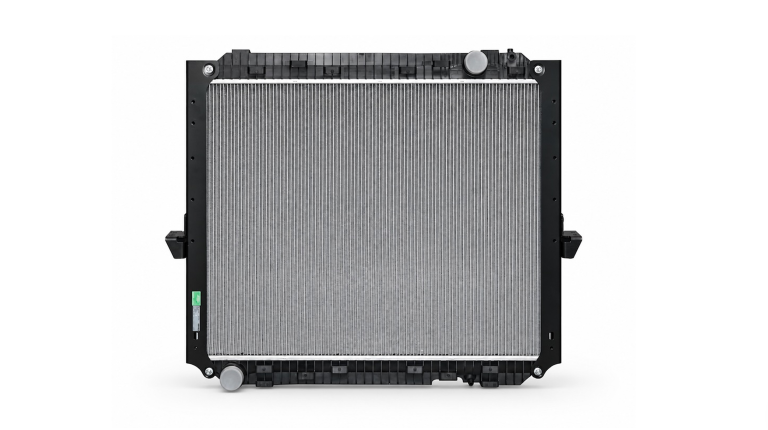
Heavy-duty and industrial cooling systems manufacturer Dolphin Global has adopted physics and engineering AI tools from cloud simulation platform SimScale to accelerate development of heat exchanger and radiator designs. The technology will be used to optimize heat transfer, reduce cooling power requirements, improve resistance to clogging in dirty environments and develop smaller, lighter cooling systems for high-power equipment.
The thermal demands placed on heavy-duty, locomotive and off-highway equipment are becoming harder to solve through conventional, sequential radiator design. AI-powered simulation gives Dolphin the ability to explore far more combinations of core, fin, tube and airflow design – helping engineers find better-performing designs in significantly less time, while balancing thermal performance, pressure drop, weight, durability, packaging and manufacturability.
Dolphin will expand its use of SimScale’s AI and advanced digital simulation tools across its heavy-duty, locomotive truck and bus, and off-highway and industrial ranges in the coming months, using the technology to run computational fluid dynamics and thermal simulations, including shell-and-tube and plate heat exchanger configurations, to optimize thermal efficiency.
Its adoption of the technology deepens Dolphin’s investment in digital-first engineering, enabling its technical team to test and refine thermal and fluid performance earlier and faster in the design cycle, ahead of physical prototyping.
“Our engineering team has always owned every stage of design and validation in-house,” said Nooruddin Jetpurwala, founder, chairman and CEO, Dolphin Global. “Bringing SimScale’s physics and engineering AI and advanced simulation capability into that process enhances our operational efficiency and time optimization. We can now test more configurations, identify issues earlier, and bring validated designs to market faster, without compromising the standards our customers depend on.”
“As equipment and vehicle thermal demands become more complex, supplier engineering teams are increasingly turning to AI and advanced simulation tools,” added David Heiny, co-founder and CEO, SimScale. “By adopting these tools, Dolphin is enabling its engineers to explore up to hundreds more design variants and move beyond conventional approaches and simple, incremental improvements to deliver the type of innovation its customers need.”
Recent news, SeoulTech develops AI framework to assess vision-system robustness