

Close Menu
Automotive Testing Technology InternationalAutomotive Testing Technology International
  • News
    • A-H
      • ADAS & CAVs
      • Aerodynamics
      • Appointments, Partnerships, Investments & Acquisitions
      • Automotive Testing Expo
      • Batteries & Powertrain Testing
      • Component Testing
      • Safety and crash testing
      • Dynamometers
      • EMC & Electronics Testing
      • Emissions & Fuel Consumption
      • Facilities
      • Full-vehicle Testing
    • I-Z
      • Interiors & Infotainment Testing
      • Measurement Tools, Test Systems & Equipment
      • Motorsport
      • NVH & Acoustics
      • Proving Grounds
      • R&D
      • Sensors & Transducers
      • CAE, Simulation & Modeling
      • Software Engineering & SDVs
      • Tire Testing
      • Webinar
  • Features
  • Online Magazines
    • September 2026
    • June 2026
    • March 2026
    • November 2025
    • Crash Test Technology – 2025
    • September 2025
    • June 2025
    • Automotive Testing Technology
    • Subscribe to Automotive Testing
    • Crash Test Technology
    • Subscribe to Crash Test Technology
  • Opinion
  • Awards
    • About
    • Eligibility and nomination
    • Get in touch
    • Judges
    • Winner interviews
  • Videos
  • Directories
    • Supplier Spotlight
    • Proving Grounds
  • Webinar
  • Events
LinkedIn Facebook X (Twitter)
  • Automotive Interiors
  • Automotive Powertrain
  • ADAS & Autonomous Vehicle
  • Professional Motorsport
  • Tire Technology
  • Media Pack
LinkedIn
Subscribe
Automotive Testing Technology InternationalAutomotive Testing Technology International
  • News
      • ADAS & CAVs
      • Aerodynamics
      • Appointments, Partnerships, Investments & Acquisitions
      • Automotive Testing Expo
      • Batteries & Powertrain Testing
      • Component Testing
      • Safety and crash testing
      • Dynamometers
      • EMC & Electronics Testing
      • Emissions & Fuel Consumption
      • Facilities
      • Full-vehicle Testing
      • Interiors & Infotainment Testing
      • Measurement Tools, Test Systems & Equipment
      • Motorsport
      • NVH & Acoustics
      • Proving Grounds
      • R&D
      • Sensors & Transducers
      • CAE, Simulation & Modeling
      • Software Engineering & SDVs
      • Tire Testing
      • Webinar
  • Features
  • Online Magazines
    1. September 2026
    2. June 2026
    3. March 2026
    4. November 2025
    5. Crash Test Technology – 2025
    6. September 2025
    7. June 2025
    8. Automotive Testing Technology
    9. Subscribe to Automotive Testing
    10. Crash Test Technology
    11. Subscribe to Crash Test Technology
    Featured
    September 2, 2026

    In this Issue – September 2026

    Automotive Testing Technology By Web Team
    Recent

    In this Issue – September 2026

    September 2, 2026

    In this Issue – June 2026

    June 1, 2026

    In this Issue – March 2026

    March 25, 2026
  • Opinion
  • Awards
    • About
    • Get in touch
    • Judges
    • 2025 Winner interviews
    • 2026 Winner interviews
    • ATTI Awards Forum
  • Directories
    • Supplier Spotlight
    • Proving Grounds
  • Webinar
  • Videos
  • Events
  • Expo
    • Future of Automotive Testing Conference
LinkedIn
Subscribe
Automotive Testing Technology InternationalAutomotive Testing Technology International
CAE, Simulation & Modeling

The future of AI-backed automotive testing and verification

Fernando Valera, CTO, Visure SolutionsBy Fernando Valera, CTO, Visure SolutionsOctober 1, 20265 Mins Read
Share LinkedIn Twitter Facebook Email
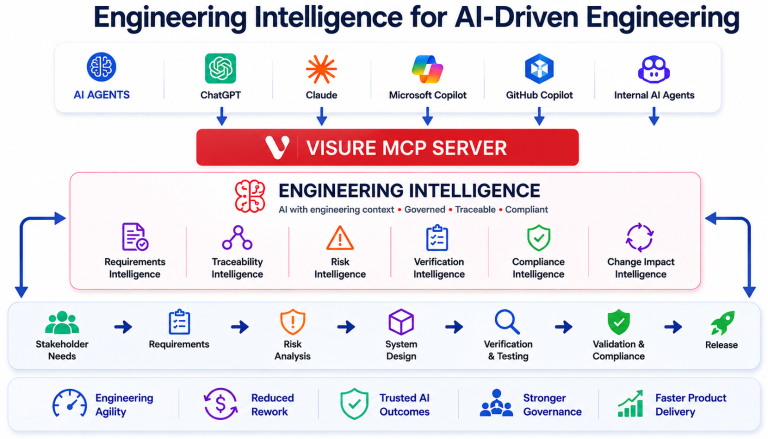
Infographic illustrating how Visure's technology supports the concept of engineering intelligence for AI-driven engineering.

As AI alters vehicle testing, engineering context will determine its impact. Fernando Valera, CTO at Visure Solutions, discusses the company’s AI agents and how they provide governed engineering context that improves agility, reduces rework, strengthens governance and accelerates product delivery 

Artificial intelligence is becoming an integral part of automotive development, promising faster test generation, automated analysis and more efficient validation workflows. Yet as vehicles become increasingly software-defined, the real challenge is no longer adopting AI, it is ensuring AI can be trusted within safety-critical engineering processes. The next evolution of automotive testing will depend on combining AI with engineering context, governance and end-to-end traceability.

The automotive industry is undergoing a profound transformation. Software-defined vehicles, ADAS, electrification, connected services and over-the-air updates have dramatically increased software complexity while shortening development cycles. Every software release must be validated against thousands of requirements across multiple vehicle domains and stringent functional safety and cybersecurity standards. As a result, verification and validation (V&V) teams are under growing pressure to accelerate testing without compromising quality or compliance.

Artificial intelligence is helping address this challenge. Engineers are already using large language models to review specifications, generate test cases, summarize technical documentation and support engineering analysis. While these capabilities improve productivity, they expose a critical limitation: generic AI understands language but not the engineering relationships that determine whether a vehicle is safe, compliant and ready for release.

AI needs engineering context

Automotive testing is built on traceability. A seemingly small software modification can affect requirements, system architecture, safety goals, cybersecurity controls, verification procedures and regression test suites. Determining those impacts requires understanding how engineering artifacts are connected throughout the product lifecycle.

Generic AI has no inherent awareness of these relationships. It may recommend a new test case or rewrite a requirement, but it cannot determine whether verification remains complete, whether a safety requirement is still satisfied, or whether a change introduces gaps in compliance. Those answers exist within the engineering lifecycle, not inside the AI model.

This challenge is becoming even more significant as SDVs receive continuous software updates throughout their lifetime. Verification teams need AI that can reason using trusted engineering information rather than isolated documents or manually supplied prompts.

Engineering intelligence for modern verification

This need is driving the emergence of engineering intelligence, an approach that combines AI with engineering knowledge, lifecycle relationships and traceability.

Instead of treating AI as a standalone assistant, engineering intelligence connects it to requirements, risks, test cases, defects, software changes and verification evidence. AI can then analyze engineering information in context, helping teams identify affected test cases, locate missing traceability, evaluate change impacts, and detect potential coverage gaps before they become costly defects.

One area where this delivers immediate value is regression testing. As software updates become more frequent, rerunning every test after every change is increasingly impractical. AI that understands engineering relationships can prioritize regression testing based on actual system impact, reducing unnecessary validation effort while maintaining confidence in software quality and functional safety.

Engineering intelligence also improves collaboration across systems engineering, software development, testing, cybersecurity and functional safety. Instead of searching across disconnected tools, teams gain faster access to the engineering knowledge needed to make informed decisions.

Trust requires governance

For safety-critical automotive systems, trustworthy AI depends as much on governance as it does on intelligence.

Standards such as ISO 26262, ASPICE, ISO/SAE 21434, and ISO 21448 (SOTIF) require engineering decisions to remain traceable, reviewable and supported by objective evidence. AI-generated recommendations must therefore remain linked to authoritative engineering data and subject to human review.

Organizations also need clear policies defining what information AI can access, how engineering data is protected, and how AI-generated outputs become part of existing approval workflows. Human oversight remains essential, not because AI lacks value, but because engineering accountability cannot be delegated.

Connecting AI to the engineering lifecycle

Providing AI with meaningful engineering context requires secure access to lifecycle information rather than isolated documents. Technologies such as the model context protocol (MCP) provide a standardized way for AI systems to retrieve governed information directly from engineering applications.

Instead of manually copying requirements, test specifications or safety analyses into external AI tools, engineers can allow AI to securely access approved engineering information while respecting permissions and organizational governance. This enables AI to analyze requirements alongside verification evidence, understand relationships between tests and risks, and support impact analysis without disrupting established engineering workflows.

Engineering intelligence in practice

Engineering Intelligence is already moving from concept to implementation. Visure Solutions supports this approach through Vivia, its AI assistant, and the Visure MCP Server.

Vivia provides contextual AI assistance directly within the engineering lifecycle, helping teams improve requirements quality, analyze traceability, assess change impacts and support verification activities using the engineering information already available within the project.
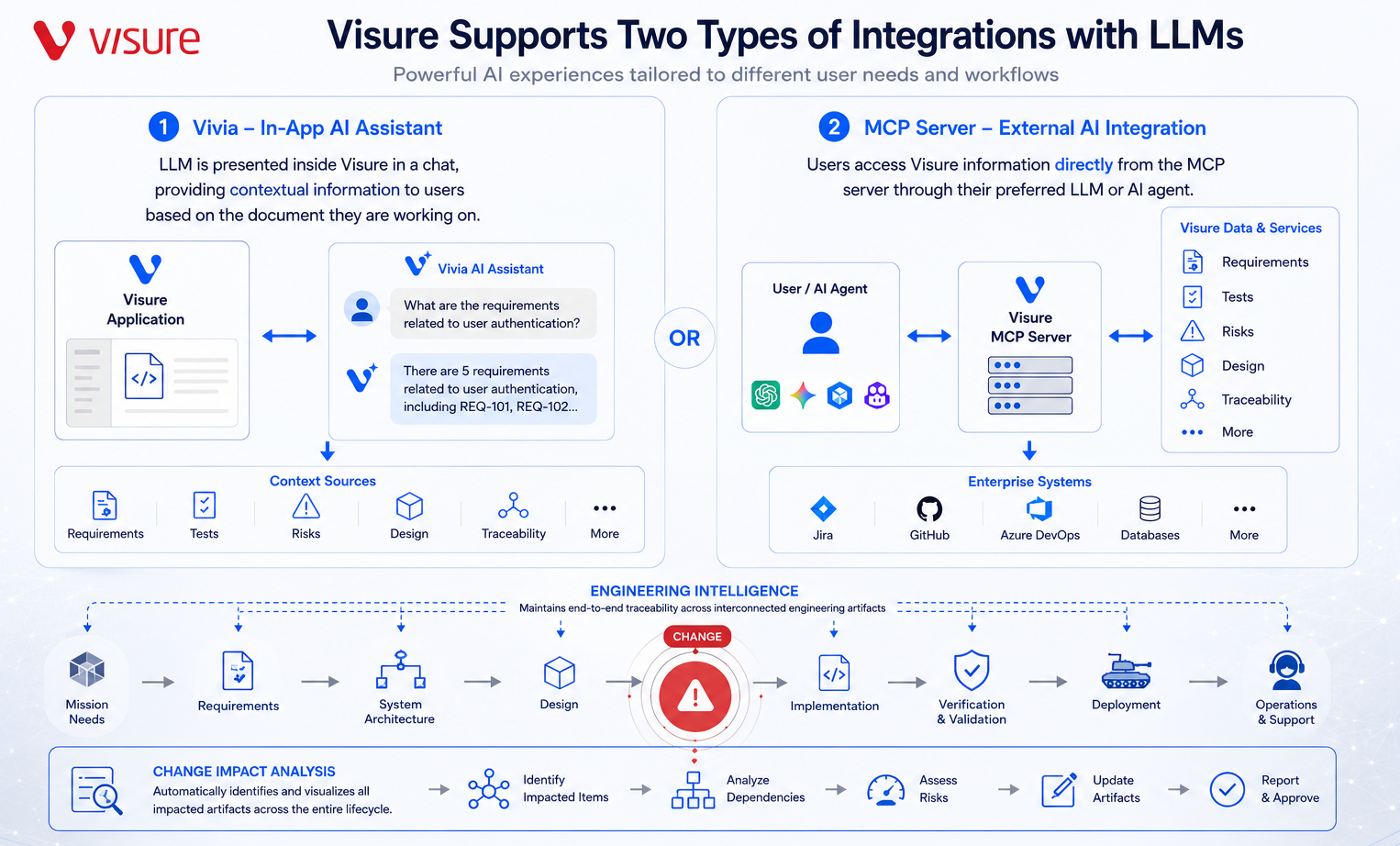
Infographic illustrating how Visure supports two types of integrations with large language models.

The Visure MCP Server extends these capabilities by securely connecting enterprise AI platforms to governed engineering information managed within Visure. Rather than relying on isolated prompts, AI retrieves trusted lifecycle data directly from engineering repositories while respecting organizational permissions, approvals and audit requirements. This enables organizations to adopt their preferred AI technologies while ensuring responses remain grounded in authoritative engineering knowledge.

Looking ahead

The future of automotive testing will not be defined simply by faster automation or more powerful AI models. It will be defined by how effectively AI can support engineering decisions within the rigorous processes that ensure vehicle safety, quality and compliance.

Engineering intelligence provides that foundation by combining AI with engineering context, traceability, governance and human oversight. For automotive verification teams, this means faster impact analysis, smarter regression testing, higher-quality requirements and more efficient validation, all while preserving the discipline required to develop safe, reliable software-defined vehicles.

Watch this webinar on engineering intelligence: High-Velocity Engineering with Visure MCP: AI Agility, Traceability & Governance
Read more about Virtual Vehicle Research’s SDV Virtual Assurance Framework in the September edition of ATTI


Share. Twitter LinkedIn Facebook Email
Previous ArticleIAAPS integrates DiL simulator with 1,800kW powertrain test facility
Fernando Valera, CTO, Visure Solutions

Fernando Valera has more than 20 years of experience in requirements and systems engineering. An IREB certified trainer, he has helped organizations across aerospace, automotive, medical devices, rail, defense and other regulated industries to improve engineering processes, traceability and compliance.

Related Posts

The Ansible Motion Delta S2 simulator, with a test engineer sitting in the cockpit.
CAE, Simulation & Modeling

IAAPS integrates DiL simulator with 1,800kW powertrain test facility

September 30, 20263 Mins Read
A graphic depicting the role and benefits of the Kigen SGP.32 v1.3-supporting automotive eSIM.
EMC & Electronics Testing

Kigen achieves GSMA eSA certification for SGP.32 v1.3-supporting automotive eSIMs

September 29, 20263 Mins Read
A glowing microprocessor sits on a dark circuit board, with electric blue and violet pathways radiating outward, evoking futuristic computing.
Measurement Tools, Test Systems & Equipment

TISA 26.10 expands AI automation and MC/DC capabilities

September 28, 20262 Mins Read
Latest News
Infographic illustrating how Visure's technology supports the concept of engineering intelligence for AI-driven engineering.

The future of AI-backed automotive testing and verification

October 1, 2026
The Ansible Motion Delta S2 simulator, with a test engineer sitting in the cockpit.

IAAPS integrates DiL simulator with 1,800kW powertrain test facility

September 30, 2026

Rethinking NVH testing for high-performance EVs

September 30, 2026
Free Weekly E-Newsletter

Receive breaking stories and features in your inbox each week, for free


Enter your email address:


Our Social Channels
  • LinkedIn
Getting in Touch
  • Free Weekly E-Newsletter
  • Meet the Editors
  • Contact Us
  • Media Pack
RELATED UKI TITLES
  • Automotive Interiors
  • Automotive Powertrain
  • ADAS & Autonomous Vehicle
  • Professional Motorsport
  • Tire Technology
  • Media Pack
© 2025 UKi Media & Events a division of UKIP Media & Events Ltd
  • Terms and Conditions
  • Privacy Policy
  • Cookie Policy
  • Notice & Takedown Policy
  • Site FAQs

Type above and press Enter to search. Press Esc to cancel.

We use cookies on our website to give you the most relevant experience by remembering your preferences and repeat visits. By clicking “Accept”, you consent to the use of ALL the cookies.
Cookie settingsACCEPT
Manage consent

Privacy Overview

This website uses cookies to improve your experience while you navigate through the website. Out of these, the cookies that are categorized as necessary are stored on your browser as they are essential for the working of basic functionalities of the website. We also use third-party cookies that help us analyze and understand how you use this website. These cookies will be stored in your browser only with your consent. You also have the option to opt-out of these cookies. But opting out of some of these cookies may affect your browsing experience.
Necessary
Always Enabled
Necessary cookies are absolutely essential for the website to function properly. These cookies ensure basic functionalities and security features of the website, anonymously.
CookieDurationDescription
cookielawinfo-checbox-analytics11 monthsThis cookie is set by GDPR Cookie Consent plugin. The cookie is used to store the user consent for the cookies in the category "Analytics".
cookielawinfo-checbox-functional11 monthsThe cookie is set by GDPR cookie consent to record the user consent for the cookies in the category "Functional".
cookielawinfo-checbox-others11 monthsThis cookie is set by GDPR Cookie Consent plugin. The cookie is used to store the user consent for the cookies in the category "Other.
cookielawinfo-checkbox-necessary11 monthsThis cookie is set by GDPR Cookie Consent plugin. The cookies is used to store the user consent for the cookies in the category "Necessary".
cookielawinfo-checkbox-performance11 monthsThis cookie is set by GDPR Cookie Consent plugin. The cookie is used to store the user consent for the cookies in the category "Performance".
viewed_cookie_policy11 monthsThe cookie is set by the GDPR Cookie Consent plugin and is used to store whether or not user has consented to the use of cookies. It does not store any personal data.
SAVE & ACCEPT