

*This article was first published in Christophorus Magazine, issue 419, a Porsche magazine. Content has been edited for PMW.
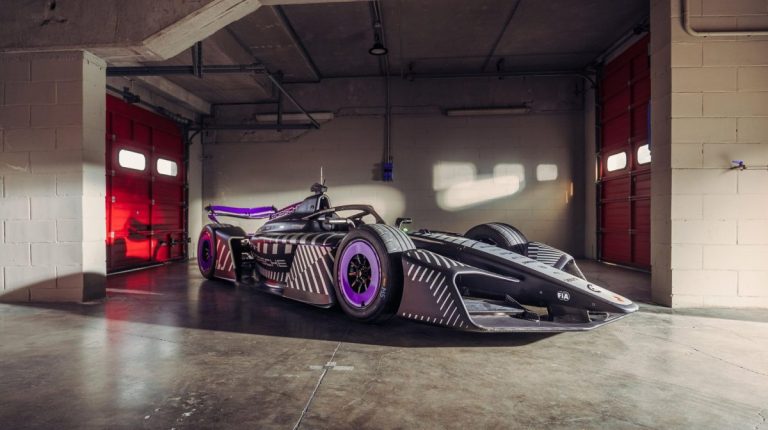
Porsche Formula E pilots will have a new model, the 975 RSE, for the coming season. The Porsche Newsroom took a deep dive into the technical development of the Gen4 race car at the Weissach Development Centre
Nico Müller, Formula E factory driver since 2024, has dubbed the new Porsche 975 RSE race car “the Beast.” A maximum of 600kW (816ps), a top speed of 335km/h, and acceleration from 0km/h to 100km/h in 1.8 seconds – these values are enough to put a smile on any race car driver’s face.
Building on the success of the predecessor: The 99X Electric
The name alone, 975 RSE, pays tribute to Porsche Motorsport’s 75th anniversary this year. The groundwork was laid when Pascal Wehrlein clinched the world championship title for drivers in the 2023/2024 season. The Porsche Formula E team went on to win the manufacturers’ and teams’ championships one year later.
The Gen4 race cars represent consistent optimization of the earlier champion vehicles. They’ll enter the 2026/2027 racing season with big wings and plenty of downforce, for a design that’s visually closer to Formula 1, but more importantly will drastically improve grip for faster cornering.
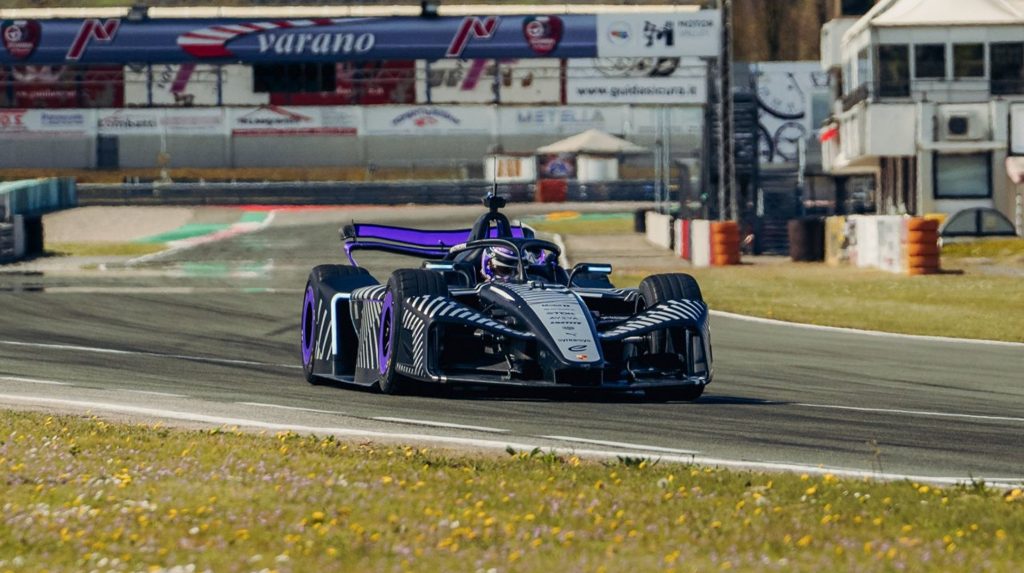
“Formula E has become so fast in just around a decade that we now need aerodynamic downforce,” said Olivier Champenois, technical project leader Formula E at Porsche Motorsport. “But there’s no downforce without drag, which increases energy consumption. To further address this topic, we have two aero packages with different body components: a low-downforce package with less drag for racing and a high-downforce package with more downforce for qualifying, where energy consumption doesn’t matter. We’re talking about up to 150% more downforce than before.”
Visually like Formula 1, internally very different
The Gen3 Evo 99X Electric powertrain achieves more than 97% efficiency, according to Porsche, compared with less than 55% for the previous generation of Formula 1 race cars. The efficiency is supported by regenerative braking, with energy recovered during deceleration and returned to the battery at rates of up to 700kW, helping the Porsche 975 RSE complete races lasting more than 45 minutes with a usable battery capacity of 51.25kWh.
In fact, the battery contains just around half the energy needed for the race at the starting line, which makes Formula E unique, Porsche says. In other words, it’s the most energy-efficient Formula race car, despite the new aerodynamics, which generate more downforce and are more susceptible to wind than before. “The 975 RSE produces 71% more peak power than its predecessor,” says Champenois.
Durability up, weight and costs down
Formula E teams operate within energy limits set by the regulations, requiring developers and drivers to maximize efficiency during races. FIA-mandated standardized components also limit the scope for teams to improve performance through in-house development, with the Gen4 regulations retaining common chassis, aerodynamic components, tires and battery systems; as efficiency improves, factors such as weight, durability and cost have become more prominent development priorities.
“Although we’re developing more components in-house, the overall weight of our parts package could not increase by more than 5kg,” says Champenois. “But we were able to make many parts lighter.”
Race car development closely mirrors the development of production sports cars in terms of agility and the myriad demands. However, the cycles in racing are much shorter.
The engineers began with the powertrain of the final iteration of the Gen3 Evo vehicles. Porsche was able to incorporate elements developed in-house: the rear-axle electric motor, the transmission, the differentials, the driveshafts and other powertrain components at the rear axle, and cooling and chassis components at the rear. Not to mention all the operating software. The 975 RSE’s control units contain more than 1.5 million lines of code, broken down into well over a hundred individual modules, each of which fulfills a specific purpose.
A whole new level of recuperation
The software also controls, of course, the energy that the wheel feeds back into the battery when the brakes are applied. That is the key performance factor on the racecourse. Recuperating lots of energy ahead of curves allows you to go full power on the next straight. The 975 RSE’s permanent all-wheel drive supports recuperation power of up to 700kW. In fact, around 50% of the racing energy used by the new Formula E race car comes from recuperation.
The oil-cooled permanent magnet synchronous motor at the rear axle has proven to be a true recuperation marvel and can alone recover energy with power of up to 350kW. An electric motor with water jacket cooling offering the same performance values would have to be around 1.5 times larger.
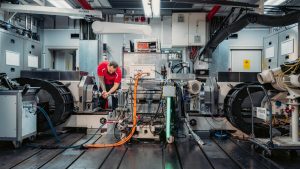
A closely related version of the 975 RSE’s direct oil-cooling system is also used in the Cayenne Turbo Electric, highlighting technology transfer between Porsche’s racing and production programs. The collaboration also extends to the test benches at the Weissach Development Centre, where components for both road and race cars are evaluated.
From the test lab to reality

Components undergo testing on the test bench when engineers want to assess their performance and durability before a complete vehicle is available. These components are integrated into the electronic loop, a digitally simulated vehicle environment.
This in-the-loop testing replaces components like control units and therefore enables testing in the lab, even if the physical vehicle exists only in fragments. The scope of this testing has further expanded with the new generation. “The Gen3 was already complex in its own right, but the Gen4 systems are much more so,” confirms Champenois. Due in part to new levels of freedom in calibrating and controlling the axle differentials. After all, every test scenario that can be reproduced on the test bench reduces development costs. The connection to series production is visible here, too.
But the test bench is not reality. Despite state-of-the-art digital tools, it still falls short of reality, which is what makes test-driving indispensable. This is especially true in racing. Nico Müller and Pascal Wehrlein have therefore been testing the 975 RSE on the racecourse since November 2025 – for final calibration of all the systems.
Fans will see the Gen4 car in competition from December 2026, when the Porsche Formula E team is set to field the 975 RSE with drivers Nico Müller and Pascal Wehrlein.
EXPLORE: Inside Stellantis’s new battery technology hub in Canada