

* This article has been written and supplied by Kistler.
Kistler reveals why conventional in-cylinder pressure calculation models may not hold up when analyzing zero-carbon fueled engines
Optimizing engines to efficiently burn zero-carbon fuels is a key task in the current shift toward a more sustainable future. A fundamental measurement requirement in the development of combustion system engines has long been the detailed analysis of combustion pressure data. However, for many, the basis for interpreting the test data still relies on calculation models for carbon-based fuel combustion. Given the chance to conduct their own extensive study at the University of Nottingham, pressure measurement experts from Kistler took a closer look at how these models hold up with these low or zero-carbon fuels. After tests with various ammonia-hydrogen mixtures, the experts were surprised by how significantly even small changes in the fuel-mix affected the derived results. The good news is that these findings might now help engineers optimize their combustion systems more efficiently.
Combustion pressure measurement gives engineers a clear image of what happens inside the engine during operation. To get relevant data, a small piezoelectric sensor is mounted directly in the cylinder head. As air and fuel are compressed and ignited, the rapidly increasing in-cylinder pressure is captured with high fidelity creating a detailed pressure curve for each combustion cycle. Based on this data, engineers know how fast the fuel burns, when exactly peak pressure is reached, how efficiently the energy is released and whether the combustion is stable. These insights are crucial for optimizing any combustion engine. They help with finding optimized combustion phasing to avoid knock or mechanical overload, improving fuel efficiency and reducing emissions.
In other words, measuring and analyzing combustion pressure is an indispensable tool for building better and more eco-friendly engines. Yet, researchers and engineers still rely heavily on simplified first-law heat release models, which typically assume fixed polytropic indices. Polytropic indices are thermodynamic parameters which lie at the core of the analysis. They describe how pressure and volume change during gas compression or expansion in the cylinder, providing insights into how much energy is retained or lost during the process.
Questioning the calculation model
The polytropic index commonly used in combustion analysis has been well established and proven in many years of research on engines burning hydrocarbon fuels. Other types of fuels, however, differ significantly in thermodynamic properties, flame speed, ignition characteristics and specific heat ratio. Experts at Kistler, a leading manufacturer of piezoelectric pressure sensors, wanted to explore the sensitivity of this aspect, with respect to zero-carbon fuels – and how much this might influence the results in engine development work. “We wondered whether parameters proven in the research of carbon fuels would hold up when applied to zero-carbon fuel combustion. So, we decided to look into it,” explains Dr David Rogers, head of ICE systems at Kistler, who led the study.
In collaboration with the Powertrain Research Centre at the University of Nottingham, the team decided to make the most of the opportunity to work with the sophisticated test equipment and research engine that the facility has.
The mixture of ammonia (NH₃) and hydrogen is increasingly considered a carbon-free fuel alternative with a high potential for heavy-duty combustion engines as used in marine propulsion applications. Ammonia and hydrogen have combustion characteristics that differ significantly from conventional carbon fuels: while ammonia has a lower burning velocity than gasoline, hydrogen has a higher one and their specific heat ratios are different as well.
The Kistler team wanted to explore whether gasoline-based assumptions are still valid for ammonia-hydrogen blends, or whether they might introduce systematic errors in burn-rate analysis, combustion phasing prediction and ignition delay estimation.
“Ammonia and hydrogen are tricky to store. Also, you need an engine that is able to burn it. Thanks to the university, we had access to both,” reveals Rogers. “We really did not know what to expect and would have been happy if nothing had shown up in our findings. But that was not the case.”
The test approach: Getting to the basis of combustion pressure analysis
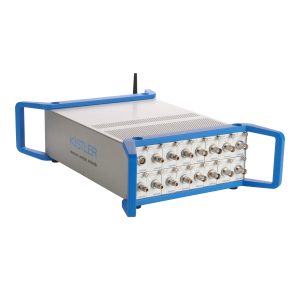
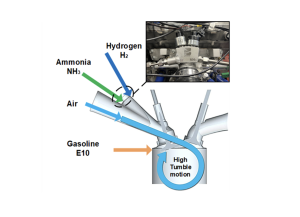
The laboratory at the university was equipped with a modern single-cylinder spark-ignition research engine with variable valve timing, direct fuel injection and a dedicated port fuel injection for ammonia and hydrogen. The high-speed in-cylinder pressure data was recorded using a Kistler piezoelectric transducer (Type 6045B), which was flush-mounted in the cylinder head. The connected KiBox2 combustion analysis system from Kistler prepared the data for interpretation. The tests covered both pure ammonia combustion and various ammonia-hydrogen blends (up to 60% hydrogen share).
The measured in-cylinder pressure was used as the main input, converting the pressure curve into an energy release curve, showing how quickly and at what crank angle the fuel’s energy is released during combustion. The research team compared the standard polytropic index based on gasoline combustion with a more detailed method: based on the measured pressure data and the specific fuel blend, the polytropic index was calculated individually for each operating point and each cycle. This enabled the Kistler team to quantify the potential error that is introduced when standard gasoline models are applied to ammonia-hydrogen combustion. Conversely, they were able to quantify the increase in accuracy achieved through fuel-specific, cycle-resolved calculations.
The results: Faced with a large potential for errors
Rogers and his team were stunned by the results. “We found the sheer magnitude of the potential errors surprising,” he says. “For some of the operational points the errors were so significant that they rendered the test results borderline unusable.”
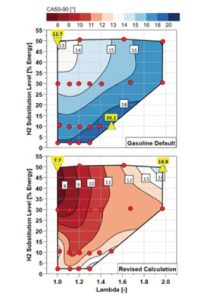
Under pure ammonia operation, the polytropic index deviated in compression by about 4% from the gasoline default value. The experts found out that the discrepancies primarily affected the late combustion phase, while the early burn phase was less sensitive. Also, combustion accelerated and modeling discrepancies decreased as the hydrogen share increased.
“Our findings show that conventional gasoline-based heat release analysis is not universally transferable to zero-carbon fuels,” summarizes Rogers. “For accurate prediction of burn duration and combustion phasing, fuel-specific or cycle-resolved polytropic indices are required.”
How these results help engineers create more sustainable engines
In day-to-day engine research and development, engineers are under a lot of pressure to quickly improve engines. Here, discrepancies in the test results require repeated measurements, making the whole process less efficient. With more accurate calculation models and, consequently, a more accurate analysis, engineering decisions can be made earlier in the development cycle.
“These combustion metrics are commonly used by our customers in their research and development, so of course we are interested in supporting them as best as we can,” Rogers explains of the motivation for their study. “Experimental work like this helps us a lot in doing so. We want the users of our technology to be confident about the quality of their analysis. The ultimate goal is to make the calculation models better and easier to use through our products. Ideally, the data is so precise and the analysis so conclusive that engineers will be able to make informed engine design decisions already during the measurement phase. This way, we can speed up development time significantly and help engineers create better and more efficient engines.”
In the next step, Kistler intends to embed these findings into its measurement technology to ensure seamless user access. The KiBox2 analysis system enables straightforward implementation of cycle-resolved polytropic indices.
Also, the team wants to do more experimental work – with different engine types and zero-carbon fuel mixtures. “This is just a small part of a bigger picture. The goal of our work is also to clear the path for more cooperations with partners from the industry and universities to continue our research,” concludes Rogers.