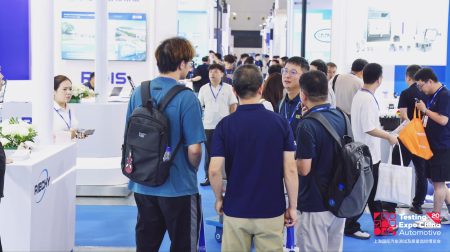


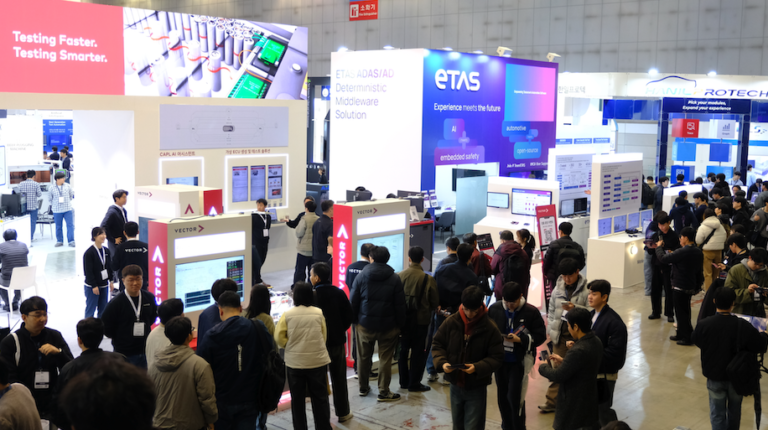
Automotive Testing Expo Korea returned to KINTEX in South Korea from March 18-20, 2026, bringing together nearly 5,000 engineers, testing specialists and technology providers for three days of technical exchange, product demonstrations and industry discussion focused on the future of automotive testing and validation.
As the automotive industry accelerates toward electrified, autonomous and software-defined vehicles, the exhibition highlighted the growing importance of advanced testing technologies, simulation tools and integrated validation strategies. Across the show floor, companies presented solutions covering the full development cycle – from early-stage simulation and virtualization to component testing, durability evaluation and full-vehicle validation.
Automation, digital engineering workflows and data-driven development environments emerged as key themes as manufacturers seek to shorten development cycles while maintaining safety, reliability and regulatory compliance.
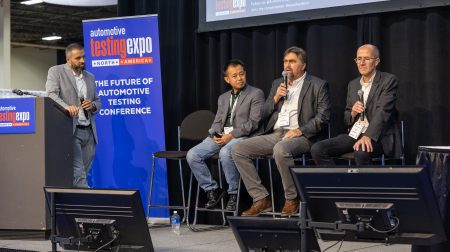
The accompanying conference program provided technical insight into emerging topics including autonomous driving technologies and electric vehicle safety evaluation, reinforcing the event’s role as a platform for both technology demonstration and industry knowledge exchange.
Exhibition highlights
The exhibition floor showcased a wide range of technologies supporting the development and validation of next-generation vehicles.
 Seoul Industrial Engineering highlighted its thermal management testing technologies designed for modern electrified vehicle systems. The company develops test equipment used to evaluate cooling and heating performance across key components including batteries, motors and inverters.
The growing importance of thermal management reflects the industry’s transition toward electrified powertrains. Sang-Taek Oh, CEO and head of the R&D Center at Seoul Industry Engineering, noted that the shift from combustion engines to electric vehicles has significantly increased the role of thermal management in vehicle development.
“As electrification advances, thermal management for batteries, motors and power electronics is becoming critical for vehicle performance and driving range,” he said.
With more than three decades of experience developing automotive test equipment, the company continues to expand its portfolio to support emerging requirements in energy management and electric powertrain validation.
GeneSys Elektronik showcased its ADMA GNSS-aided inertial measurement systems, widely used for vehicle dynamics testing, ADAS development and validation.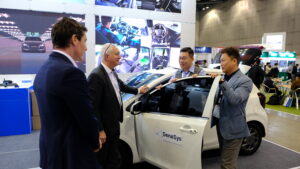
The company also introduced SensorX, a detector designed to identify audiovisual warning signals inside vehicle cabins. Such technologies support the testing and validation of increasingly sophisticated driver assistance and safety systems.
GeneSys highlighted Korea as an important market for advanced vehicle testing technologies and emphasized the value of engaging directly with OEMs, Tier 1 suppliers and engineering specialists during the exhibition.
Elsewhere on the show floor, companies including Vector Korea, Hioki Korea, Innosimulation, Suresoft Technologies, Autocrypt, Tosun, imc Korea, ETAS Korea and dSPACE Korea presented technologies supporting ADAS and autonomous vehicle testing, electrified powertrain development, NVH and durability analysis, as well as simulation and digital twin platforms.
Together, the exhibits reflected the increasing complexity of modern vehicle systems and the growing demand for integrated testing and validation tools capable of supporting both hardware and software development.
Conference insights
The Automotive Testing Expo Korea conference delivered a series of technical discussions addressing the evolving challenges of vehicle testing and development.
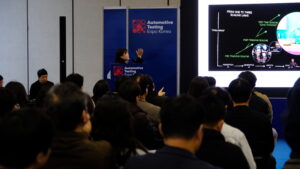 In a keynote presentation, Dr Jeong Dan Choi from the Electronics and Telecommunications Research Institute explored the evolution of autonomous driving technologies. She highlighted how the industry is moving away from isolated functional modules toward large-scale AI models and end-to-end architectures trained on extensive real-world datasets.
According to Choi, the next stage of autonomous driving development will depend heavily on access to large-scale data and open ecosystems that allow companies and research institutions to collaborate on model development and real-world validation.
Lee Eundok, research fellow at the Korea Automotive Testing and Research Institute (KATRI), presented the latest developments in the KNCAP safety evaluation framework for electric vehicles.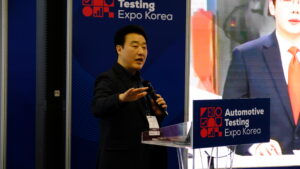
With EV adoption continuing to grow under Korea’s Electric Vehicle Distribution and Promotion Policy, Lee emphasized that safety evaluation frameworks must evolve alongside new vehicle technologies.
“As electric vehicle sales continue to increase, improving safety remains essential,” Eundok explained. “The evaluation strategies introduced through KNCAP aim to strengthen vehicle safety in Korea and contribute to safer vehicles globally.”
He also noted that technical forums such as Automotive Testing Expo Korea provide valuable opportunities for engineers, regulators and industry leaders to exchange ideas and collaborate on improving vehicle safety standards.
Visitor feedback
Visitors from OEMs and Tier 1 suppliers highlighted the value of the event in providing access to both new technologies and expert knowledge.
An engineer from BMW Korea working on cybersecurity certification said the conference sessions and exhibition were particularly relevant to current industry challenges: “With increasing requirements related to cybersecurity and autonomous driving technologies, we were interested in the seminar sessions organized during the expo,” he said. “There are many relevant companies here, and we were able to gain useful insights and explore solutions that support our work.”
Meanwhile, a thermal management engineer from Hyundai Mobis noted that the exhibition provided an opportunity to explore new testing approaches and measurement technologies: “Many of the systems on display are more advanced than the equipment we currently use,” he said. “It was valuable to see a wider range of technologies and consider solutions that could improve our testing and development processes.”
Looking ahead
Automotive Testing Expo Korea 2026 highlighted the rapid evolution of vehicle testing and validation technologies as the automotive industry continues its transition toward electrification, autonomy and software-defined vehicle architectures.
Across both the exhibition and conference program, the event demonstrated how simulation tools, integrated measurement systems and automated validation environments are becoming essential components of modern vehicle development.
Information about the next edition of the event will be announced on the Automotive Testing Expo Korea website