

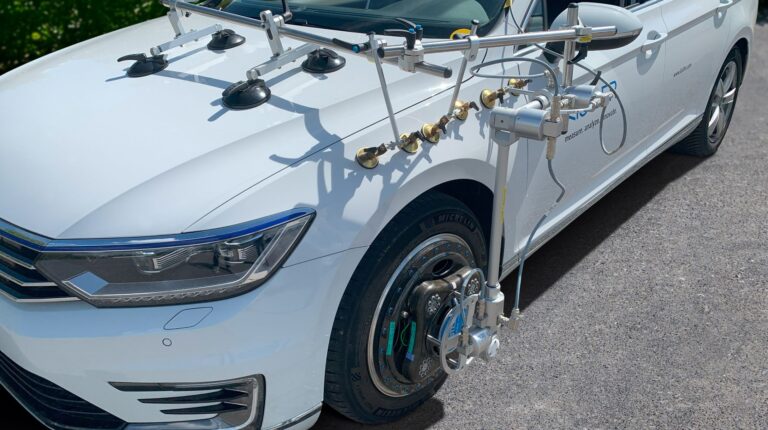
The latest RV-5 wheel vector sensor from Kistler measures wheel movements across five axes – steering angle, camber angle, and displacement in the X, Y and Z directions – with improved accuracy and durability. Updated electronics featuring magnetic encoders enhance measurement quality while maintaining full compatibility with the previous RV-4 model.
Wheel position and orientation measurements are critical for applications including wheel arch and component clearance verification, elastokinematic simulation validation and chassis and tire development. Stable and reproducible data is especially important in motorsport and vehicle dynamics control systems such as ESC, torque vectoring and advanced driver assistance systems and automated driving, particularly under challenging conditions including dust, water spray and high vibration.
Efficient measurements
The heart of the sensor, consisting of several encoders and electronics, has been completely redesigned, with magnetic encoders replacing the previous optical encoders.
The RV-5 connects directly to the wheel carrier structure and measures the wheel vectors at the source. Consequently, measurements remain stable and reproducible in rain, dust, splash water or abrupt changes in light. The factory calibration in the vehicle coordinate system remains stable across temperature and vibration changes; recalibrations, as required with camera-based setups, are not necessary.
The sensor resists optical interference and delivers reliable, high-precision, low-latency data on rough roads, curbs and under high lateral and vertical accelerations, even where camera- and optics-based systems struggle.
Magnetic encoder
The magnetic encoders provide higher linearity and stability, delivering clean, high-resolution data across the full range, even under dynamic loads. Lower sensor noise produces smoother raw signals that require less filtering and are available with reduced latency.
Oliver Plenter, business development manager at Kistler, said, “Magnetic encoders make our wheel vector sensors even more robust and precise without disrupting customers’ established setups. Plug in, configure, measure – everything as usual, but with even higher quality.”
Related news, BeyondMath raises US$18.5m to scale foundational physics AI model