
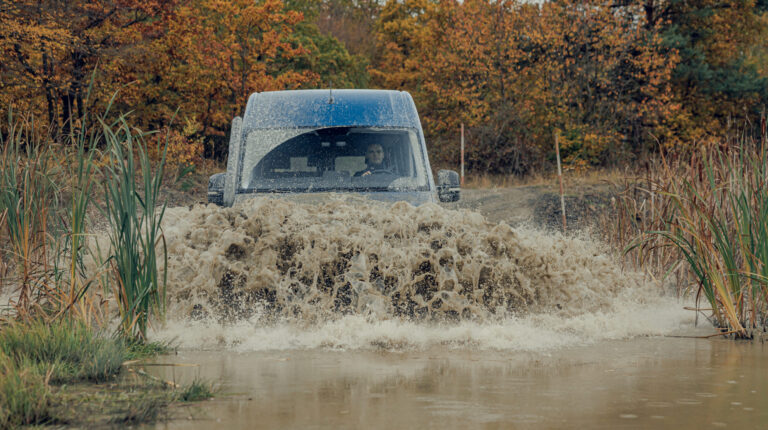
The Torsus Terrastorm 4×4 HD has been put through its paces in a 90-day RAM-D (reliability, availability and maintainability – durability) validation program at the VTÚ Military Technical Institute facility in the Czech Republic. RAM-D testing evaluates reliability, availability, maintainability and durability, exposing a vehicle to conditions beyond normal use. For the all-wheel-drive minibus, the program was designed to validate the vehicle’s capability, durability and serviceability under demanding load, terrain and environmental conditions.
Analyses were carried out while the vehicle was fully loaded to its 5.5-metric-ton gross vehicle weight (GVW), subjecting the platform, drivetrain, suspension and body structure to repeated high-load impacts, water crossings, mud, side-tilt evaluation and endurance running.
Developed for specialist conversion and demanding civil applications, the Terrastorm 4X4 HD provides a base for emergency response, utility, expedition, remote access, mobile workshop, support vehicle and heavy-duty passenger transportation requirements.
Vakhtang Dzhukashvili, the founder and CEO of Torsus, commented, “The Terrastorm 4×4 HD was created because we saw a clear demand for a heavy-duty, long-wheelbase 4×4 platform with the strength, traction and versatility required for specialist conversion and demanding real-world use. Operators working in remote, challenging or unpredictable environments need vehicles that can carry weight, cover difficult ground and continue performing where conventional platforms reach their limits. That is exactly where Terrastorm has been engineered to operate.
“Completing this 90-day RAM-D validation program is an important milestone for Torsus and for the Terrastorm 4×4 HD. The vehicle has been tested under load, across demanding terrain and through a program designed to reflect intensive real-world use. That gives customers confidence not just in what the vehicle promises, but in what it has proven it can do.
Over the course of the program, the Terrastorm 4×4 HD covered 15,000km while fully loaded. This lifetime test in a combined cycle simulates intensive operational use and equates to 45,000-60,000km of normal driving.
It was driven repeatedly through still and moving water up to 800mm deep, replicating real-world scenarios including river crossings, flooded roads and operations across unstable terrain. High-speed water testing was also conducted to validate the company’s in-house-developed snorkel system and custom breathers for axles and transmission. Tests confirmed stable engine airflow and effective drivetrain sealing, supporting reliable operation even in fast-flowing or flooded terrain.
Terrastorm’s suspension was subjected to extreme dynamic testing, including jump trials designed to simulate severe off-road impacts. Results confirmed strong structural resilience, energy absorption and ride stability under full-payload and high-impact conditions.
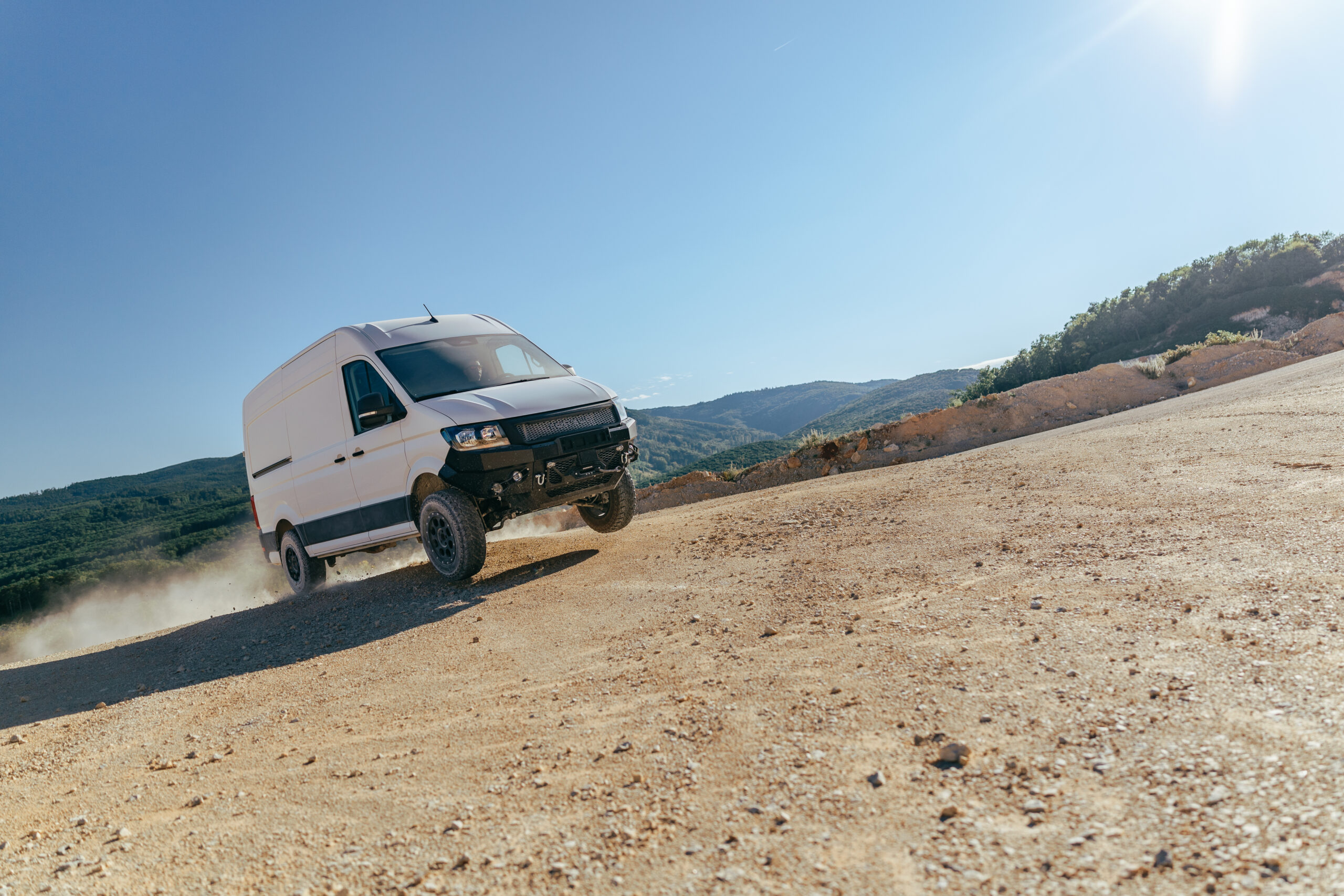
The heavy-duty minibus drivetrain was assessed across deep water, mud, ruts and broken terrain. With low range engaged and differential locks activated in conditions including deep holes and diagonal wheel lifts, the system maintained steady forward progress.
Full-scale mud trials were conducted with the vehicle loaded to its GVW. The test site featured deep, sticky clay, uneven trenches and variable traction zones, each designed to challenge drivetrain response, torque distribution and wheel-slip management.
At the VTÚ facility, additional validation included a side-tilt test conducted on the Cargo version of the Terrastorm, fully loaded with euro pallets. The assessment evaluated weight distribution and center of mass under full-payload conditions and extreme lateral forces. Results confirmed that the Terrastorm maintained stability, balance and predictable handling throughout.
The vehicle’s reinforced steel bumper, custom-built by the Torsus in-house engineering team, was assessed for its ability to protect the front structure, powertrain components and lighting units from impacts with rocks, debris and uneven terrain, while its robust geometry supports approach angles and clearance in severe off-road environments.
“With locking differentials, a low-range gearbox, a 5.5-metric-ton platform and the durability required for specialist conversion, Terrastorm gives operators a highly capable base for a wide range of applications, from expedition and emergency-response vehicles to mobile workshops, utility support units and heavy-duty passenger transport. We believe it sets a new benchmark for heavy-duty 4×4 minibuses,” said Dzhukashvili.
In related news, Audi A2 e-tron racks up the miles during validation testing
In the June edition of the mag, ATTI explores the challenges of agricultural vehicle analysis