

The Yokohama Rubber Company has developed a proprietary tire mold design support system that uses simulations (FEM – finite element method) and the company’s AI technology.
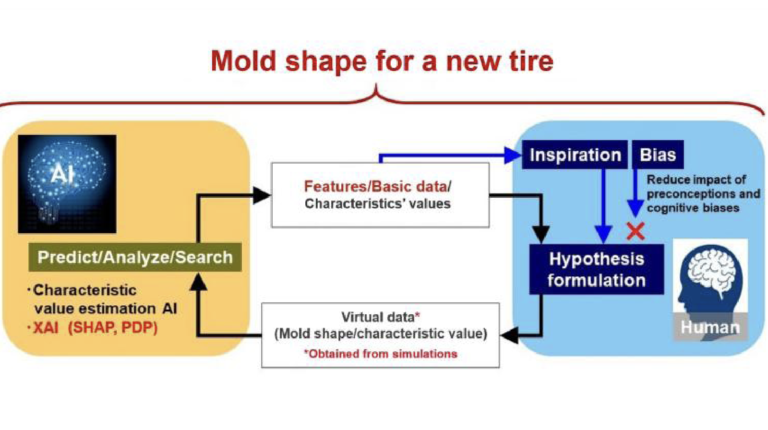
The new system supplements the knowledge and experience of the company’s development staff and reportedly makes it easier for less-experienced staff to design new molds by providing information (such as changes in tire characteristics due to different mold design factors) obtained by conducting a large number of virtual experiments.
According to Yokohama, this system accelerates mold development while reducing costs and the reworking often required to realize a new mold design. By facilitating a greater understanding of the relationship between mold design factors and tire characteristics from multiple perspectives, it will give development staff new insights and enable them to design tires capable of higher performance levels.
The system was developed using Yokohama Rubber’s proprietary HAICoLab AI utilization concept. It automatically generates a large number of tire FEM models with different mold shapes, then calculates tire characteristics in a virtual space. The calculation results are used as training data to construct an AI model (surrogate model) that instantly predicts the relationship between mold design factors and tire characteristics. By applying XAI (explainable AI) technologies such as SHAP (Shapley additive explanations) and PDP (partial dependence plots) to this newly developed AI model, Yokohama Rubber development staff can easily determine how much they need to alter each mold design factor to achieve the targeted tire characteristics.
In related news, Pirelli develops bespoke P Zero R tires for Audi RS 5 and RS 3 Competition Limited