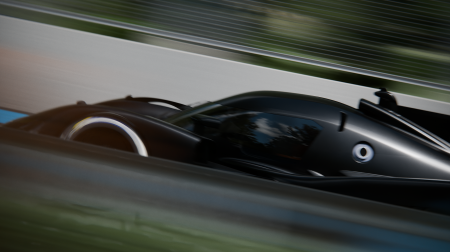



Toyota Gazoo Racing (TGR) has unveiled two models – the GR GT and GR GT3 – marking the first public display of their under-development prototypes.
From the earliest concept stage, development followed a one-team approach led by Toyota Motor Company (TMC) chairman Akio Toyoda. Professional drivers Tatsuya Kataoka, Hiroaki Ishiura and Naoya Gamou, along with gentleman driver Daisuke Toyoda and in-house evaluation drivers, worked closely alongside engineers throughout the process.
The cars are positioned as modern flagships built on the legacy of the Toyota 2000GT and Lexus LFA. One of the aims of their development is to preserve and pass on Toyota’s principles of car making to the next generation of engineers. The project brought together LFA development veterans and younger engineers, introduced Toyota-first technologies to boost performance, and embraced a range of unprecedented engineering challenges.
Three key elements of the GR GT
The GR GT was conceived as a road-legal race car, designed with a driver-first philosophy to deliver exceptional performance and a strong sense of car-driver unity. It features a hybrid powertrain combining a newly developed 4.0-liter V8 twin-turbo engine with a single electric motor, targeting over 650PS and 850Nm of torque.
Development focused on three key elements: a low center of gravity, lightweight yet rigid construction and optimized aerodynamics.
Development of the GR GT focused on achieving an exceptionally low center of gravity by lowering both the overall vehicle height and the driver’s seating position. A front-engine, rear-wheel-drive layout was chosen for precise handling. Heavy components, including the 4.0-liter V8 twin-turbo engine with dry-sump lubrication and rear-mounted transaxle, were optimally positioned to lower the vehicle’s center of gravity. The driver’s position was tuned so that the driver’s and car’s centers of gravity align, reportedly enhancing unity and handling.
The GR GT features Toyota’s first all-aluminum body frame. Additionally, the company says that appropriate use of carbon-fiber-reinforced plastic (CFRP), plastic and other materials in the body panels has resulted in a strong yet light body.
In pursuit of aerodynamic performance, exterior styling involved a process that was new to Toyota. Although the company usually turns its attention to aerodynamics only after the exterior styling is finalized, the ideal aerodynamic performance of the GR GT was established first, followed by consideration of exterior styling. Aerodynamics engineers and exterior designers worked together to achieve styling that pursues aerodynamic and cooling performance.

Developing the GT and FIA GT3-spec race car
The GR GT3 also features a low center of gravity, low weight with high rigidity and excellent aerodynamic performance. It also meets the specifications of the Federation Internationale d’Automobile (FIA) GT3, which is the top category of production-vehicle-based customer motorsports.
In developing the GR GT and GR GT3, TGR used a range of methodologies informed by its motorsports experience, including vehicle research and development using a driving simulator. By introducing a simulator early in the process, engineers were able to efficiently refine the fundamental characteristics of the cars from the outset.
Alongside simulator-based development, extensive real-world testing was carried out not only on proving grounds such as Toyota Technical Center Shimoyama but also at circuits around the world, including Fuji Speedway and the Nürburgring. These tests allowed TGR to verify high-limit performance and long-term durability. GR GT testing was also conducted on public roads to ensure the vehicle delivers exhilaration, intuitive handling and confidence in everyday driving.
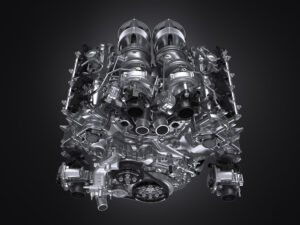
Four-liter, V8 twin-turbo engine + rear transaxle
The GR GT’s 4-liter, V8 twin-turbo engine, which is TMC’s first to be fitted in a production vehicle, is based on a thoroughly compact and light design concept. With a bore and stroke of 87.5 x 83.1, the engine’s short stroke reduces overall engine height, while its hot-V configuration positions one turbo in each engine bank. The engine also features dry-sump lubrication and an oil pan that is thinner than usual.

The engine’s power is transmitted to the rear transaxle via a CFRP torque tube. In addition to a motor-generator, the transaxle integrates a newly developed 8-speed automatic transmission, which uses a wet-start clutch in place of a torque converter, and a mechanical limited-slip differential.
The development targets call for a maximum system output of at least 650PS and a maximum system torque of at least 850Nm. In addition, using a rear transaxle and strategically positioning the drive battery, fuel tank and other heavy components has achieved a 45:55 front-to-rear weight distribution, enhancing the vehicle’s handling stability and responsiveness.
Development of the powertrain involved advancing studies through the use of race development driving simulators and system benches onto which entire powertrain systems could be mounted. Consideration was also given to thermal management, mounting position and serviceability.
In related news, next-gen Tatuus T-326 Formula Regional European Championship car debuts at Monza