

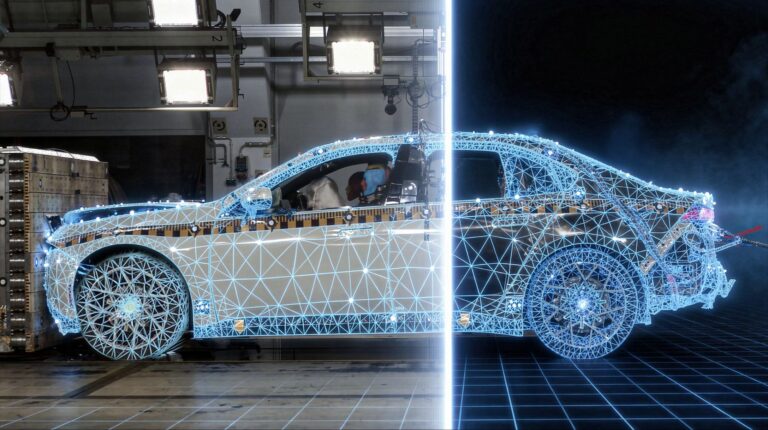
BMW Group and Mistral AI are partnering to advance the use of artificial intelligence in crash simulation to improve quality, accuracy and speed in complex engineering tasks. The collaboration marks a first step toward scaling domain-specific AI across further areas of vehicle development and the BMW Group value chain.
“For the BMW Group, the use of industrial data is a key factor in translating artificial intelligence into value creation,” said Dr Franz Decker, CIO and senior vice president of the BMW Group. “By combining our engineering datasets with Mistral AI’s model training capabilities, we are building specialized AI which supports complex development tasks.”
Complexity and data volume in crash simulation
Each week, BMW runs thousands of virtual crash simulations, generating vast amounts of engineering data. Over time, this has resulted in a historical dataset of over one petabyte of crash simulation data that provides highly detailed insights into vehicle structures and material behavior, forming a unique foundation for training an industrial AI model.
“As Industrial AI becomes the new frontier for AI, we are proud to partner with the BMW Group” said Marjorie Janiewicz, chief revenue officer of Mistral AI. “This collaboration shows how industry specific AI models can help solve complex engineering challenges such as crash simulation.”
Large industry model as a technical foundation
To scale this approach, the BMW Group is focusing on large industry models. These are AI systems trained on industry-specific engineering and simulation data from vehicle development and safety testing. Unlike general‑purpose AI systems, LIMs embed domain‑specific knowledge directly into the AI model. This requires not only industrial data, but also deep domain expertise and technical environments that enable AI systems to learn directly from BMW’s development processes.
Related news, Next-generation Helm.ai models deliver full-HD 360° synthetic driving environments