

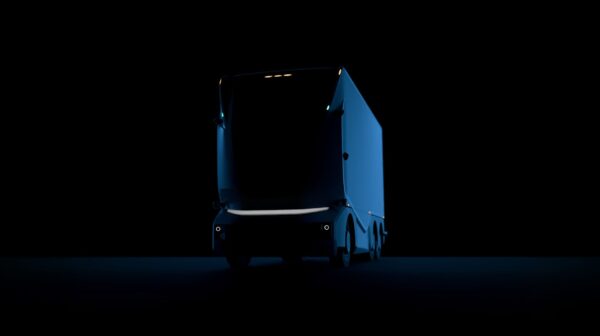
Einride AB has released its Voluntary Safety Self-Assessment (VSSA), becoming the first operator of SAE Level 4 cab-less heavy-duty trucks to publish such a document. The assessment outlines the company’s approach to the design, testing, deployment and operation of its all-electric autonomous freight vehicles.
The VSSA is intended to support transparency and regulatory engagement as Einride expands commercial operations. The company said it continues to work with the US Department of Transportation, National Highway Traffic Safety Administration and international authorities.
The document details the safety framework underpinning Einride’s autonomous technology platform, which combines its AI-based optimization software, Saga AI, with its in-house autonomous driving system, Einride Driver. These systems support the company’s Freight capacity as a Service and technology licensing offerings.
At the core of the VSSA is Einride’s cab-less, cargo-only electric truck, designed specifically for driverless operation. The vehicle incorporates redundancy across steering, braking, power, sensing and compute systems to enable fail-safe and fail-operational performance.
Einride’s safety approach is based on a documented safety case aligned with industry standards, including UL 4600, ISO 26262 and ISO/PAS 21448. This framework defines the vehicle’s operational design domain (ODD), performance requirements, fallback strategies and lifecycle safety processes.
The company states that its autonomous system combines machine learning-based driving with an independent deterministic safety layer. It also uses a redundant sensor suite including cameras, radar and lidar, alongside high-definition mapping.
The VSSA outlines procedures for minimal risk maneuvers and safe-state transitions when system or environmental limits are reached. Validation methods include simulation, hardware- and vehicle-in-the-loop testing, proving-ground trials and site acceptance testing prior to deployment.
Einride also describes its safety management system (SMS), which draws on practices from aviation and defense sectors. The system governs risk management, safety assurance, continuous monitoring and includes a fleet-wide grounding policy overseen by an independent safety and security function.
Additional areas covered in the assessment include cybersecurity and data protection aligned with ISO 21434 and ISO 27001, crashworthiness and post-crash behavior, event data recording, emergency response planning, and first-responder training.
In related news, eFreight Autonomous secures funding to explore the feasibility of autonomous HGVs on UK roads