


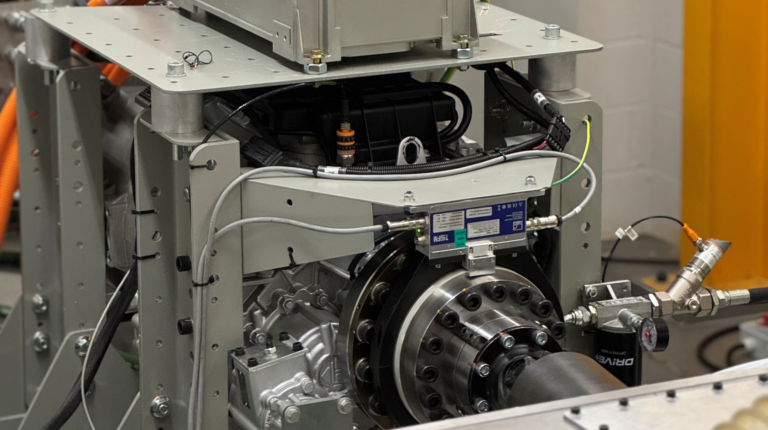
As manufacturers push for shorter development cycles, reliance on virtual engineering and validation is growing fast. High-fidelity simulation and model-based design allow teams to iterate concepts more quickly than ever, but physical testing remains a vital part of the development chain. Rob Smith, head of development and test at propulsion system development partner Drive System Design, explores physical and virtual testing
Physical tests at any level introduce risks. These include logistical and planning challenges, as well as additional program costs. Despite this, the demand for focused testing to support model correlation is increasing. Robust design verification (DV) and product validation (PV) programs remain non‑negotiable, underpinning confidence in product safety and performance.
The purpose of physical testing
Testing has always been a necessary way to quantify and assess many aspects of a product’s performance and characteristics.
Physical test results have long been the benchmark against which computer-aided engineering (CAE) models are correlated – a necessary step to ensure simulations represent reality for the full range of operating conditions.
Recent trends
With ever-improving computational power, product development programs are increasingly starting with the creation of digital twins, which are high‑fidelity, virtual representations of physical systems or components. Rather than acting solely as a pass/fail assessment, early test cycles are now tailored to strengthen model accuracy – deliberately selected load cases, boundary conditions and sensor arrays feed the virtual model with targeted data.
Test phases often mirror elements of conventional DV plans, but with a different emphasis, focusing on correlation points and characterization boundaries that make the digital twin trustworthy across the design space. That can mean smaller, more impactful tests executed quickly and iterated frequently.
Reducing risk through early virtual correlation
While physical testing is still a necessary part of any development program, early correlation with virtual models and simulations minimizes technical, fiscal, logistical and schedule risks. Issues discovered late in a program or close to production are far more expensive to fix and can jeopardize launch timelines. In extreme cases, they can even damage consumer confidence and brand reputation.
Equally important is the less quantifiable but critical return on investment – confidence. Confidence to scale production, to pass certification cycles with fewer surprises, and to stand behind a product in service. Well-executed test programs reduce uncertainty. They give engineering, manufacturing and business stakeholders the evidence to make faster, bolder decisions.
Will digital twins replace the need for physical tests?
Digital twins are powerful accelerants. They let engineers explore options, run virtual what‑if scenarios and optimize systems faster than physical prototypes allow. But regardless of how well correlated they are, digital twins cannot capture every real‑world uncertainty.
There are factors that can only arise during physical testing, such as manufacturing variability, material property deviations or defects, and subtle system‑to‑system interactions. These can defeat even the best virtual model. Some sectors – aerospace is a notable example – have tightly controlled material processes that reduce this uncertainty, but that control comes at the expense of longer development cycles and higher cost.
Physical testing is the data source that validates and calibrates digital twins. It supplies ground truth for material behaviors, component interactions and environmental influences. In turn, validated digital twins enable predictive maintenance strategies, support virtual certification scenarios and let teams explore failure modes that would be destructive or impractical to test physically. The sooner a manufacturer can build and trust a digital twin, the more effective and efficient the subsequent development cycles become.
What can we expect in the future of testing?
The pace of testing progress will be driven by two technical shifts: increased modeling capability and faster, higher‑quality test data.
Modeling is becoming more accessible. Computational power and improved numerical methods now make it commercially viable to model fluid systems and thermal‑mechanical interactions that were once prohibitively expensive. Improved simulation of splash lubrication, transient cooling and multi‑physics coupling is already narrowing gaps to physical testing.
Real‑time processing and near‑continuous model updates will become standard practice. This places new demands on instrumentation, automation and test engineers. To capitalize on shorter development cycles, test systems must deliver reliable data at much higher rates and with faster post‑processing.
An example from development practice is a highly automated maximum torque per amp (MTPA) optimization routine. By combining machine learning, advanced test equipment and in‑house control and automation systems, it is possible to iterate tens of thousands of operating points in a matter of days. This delivers processed results ready for immediate analysis, which can be fed back into digital twins quickly, shortening the loop between hypothesis, test and update.
We should also expect innovation in measurement techniques and sensors. Telemetry solutions for rotor temperature, non‑intrusive torque measurements, and compact, high‑accuracy speed sensors are examples that will enable new test regimes. Treating test capability as strategic infrastructure by investing in well‑designed assets, integrating them into early design phases and using their data to feed both physical and virtual models will be essential.
Testing as a strategic enabler
Testing is often seen as a validation chore at the end of development. In a world of digital twins and rapid iteration, testing should be reframed as an enabler. It can be the provider of trusted data that lets virtual engineering unlock value.
The future will not see physical testing disappear. It will see testing become faster, more expansive in terms of data acquired, and more deeply integrated with simulation. This shift will reduce program risk, speed up time-to-market and, ultimately, enable the kind of propulsion innovation the industry continues to demand.
For engineers and program leads, the practical takeaway is simple: treat physical development testing as strategic. Build virtual model correlation into early test plans, invest in the right instrumentation and test equipment, and use those test results to mature digital twins as early as possible. Do that, and testing will shift from a necessary overhead into a competitive advantage.
Explore: Electroformed contacts set to redefine high-end electronics testing