



Andrea Leitner, global business segment manager for ADAS/AD tools and solutions at AVL, discusses how the company can help developers face the Euro NCAP 2026 protocol head-on
With the release of the new protocol from Euro NCAP, engineering teams across the automotive industry are facing one of the most significant safety shifts in recent years. The new framework broadens the assessment far beyond impact performance, demanding proof of prevention, protection and recovery under a wide range of real-world conditions. As manufacturers redefine their validation strategies, a clear understanding of what is changing – and what it takes to earn five stars – is becoming essential.
New era of safety evaluation
Euro NCAP 2026 marks a decisive evolution in how vehicle safety is measured. What was once a collection of primarily crash-focused tests has become a comprehensive lifecycle assessment. Vehicles are now evaluated before a crash, during impact and after a collision.
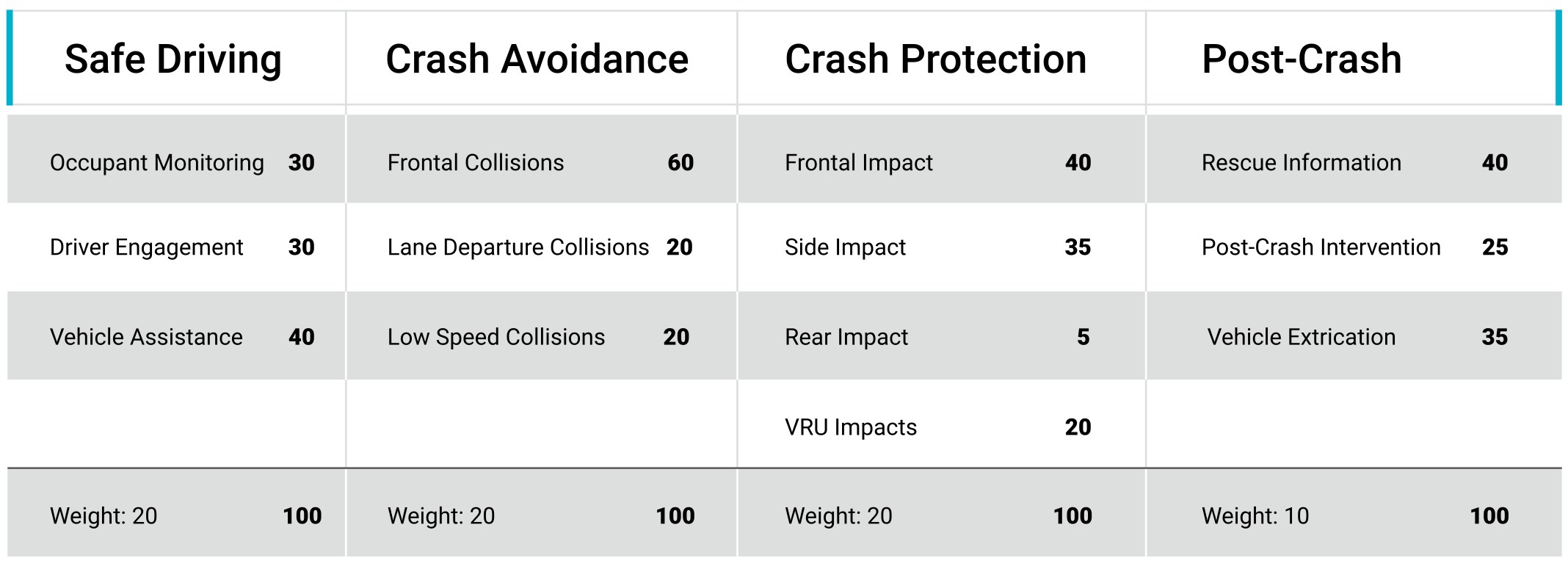
For manufacturers, this shift means that safety performance can no longer be treated as a set of isolated technical achievements. Instead, development and validation must reflect the interactions between systems, environments and driver behavior.
From functions to interactions
The expanded protocol widens the focus from individual ADAS functions to the way they behave collectively in realistic conditions. Under Euro NCAP 2026, advanced driver assistance features are tested in a much broader range of scenarios, including motorcyclist detection, turning and junction maneuvers, reverse operations, and varying light, weather and road geometries.
Safe driving evaluations now consider how effectively a vehicle keeps drivers attentive, engaged and supported during everyday operation. Driver monitoring, speed limit recognition over extended road distances, and adaptive cruise control performance all contribute to these assessments.
Crash protection introduces more detailed structural testing, far-side impact evaluations and additional requirements for vulnerable road users. Post-crash safety examines whether functions such as eCall, hazard activation and EV battery isolation remain reliable even after intense structural deformation.
Together, these changes mark a shift from evaluating what systems can do to assessing how consistently they perform when conditions deviate from ideal assumptions.
Increasing demands for validation
The expanded scope significantly increases the volume and complexity of required validation. Euro NCAP 2026 formally accepts virtual testing in ADAS and active safety assessments, enabling manufacturers to explore scenario variations that would be impractical to reproduce physically. At the same time, physical proving ground tests remain indispensable for confirming behavior under controlled yet realistic conditions.
Validation is expected to demonstrate robustness across various scenarios. Speed limit information functions require thousands of kilometers of road verification, while lane support and adaptive cruise control must show stability across higher speeds, different road geometries, and transitions between driver-controlled and assisted states. As systems become more interconnected, the margin for isolated weaknesses diminishes and consistency across domains becomes a decisive factor.
Why manufacturers must act now
Traditional, late-phase validation workflows are no longer sufficient. The 2026 update demands earlier planning, broader scenario coverage and tightly coordinated testing strategies. Ensuring alignment across simulation, public road assessment and proving ground execution is more essential than ever to avoid bottlenecks, misinterpretations and costly redesigns late in development.
While the new requirements present clear challenges, they also give manufacturers the opportunity to showcase leadership in safety – a key differentiator for consumers and regulators alike.
A clear path forward
To help organizations prepare, AVL has published a practical white paper that breaks down the Euro NCAP 2026 protocol and provides a structured approach to achieving five-star performance. The paper explains how to interpret the most influential requirements, manage cross-domain interactions and build scalable validation workflows that combine virtual testing, road assessments and proving ground execution. It also outlines how teams can prioritize the functions that have the greatest impact on scoring, avoid common pitfalls and establish a safety framework that can adapt to future protocol revisions.

Preparing with confidence
Euro NCAP 2026 represents a major step forward for vehicle safety. The new protocol demands broad, consistent performance across prevention, impact protection and post-crash support – and rewards manufacturers who treat safety as a connected, lifecycle-driven discipline. As requirements expand, development teams will increasingly rely on solutions that automate evaluation steps, interpret protocol logic correctly and deliver traceable results under tight testing schedules.
AVL supports this transition with engineering expertise and tools designed specifically for the demands of Euro NCAP 2026. Among them, the Smart ADAS Analyzer provides automated, protocol-aligned assessment and standardized reporting, helping teams run complex proving-ground campaigns efficiently and with confidence. By combining precise data handling with up-to-date evaluation logic, such solutions help manufacturers manage the growing test volume and build a reliable path toward five-star performance.