

Close Menu
Automotive Testing Technology InternationalAutomotive Testing Technology International
  • News
    • A-H
      • ADAS & CAVs
      • Aerodynamics
      • Appointments, Partnerships, Investments & Acquisitions
      • Automotive Testing Expo
      • Batteries & Powertrain Testing
      • Component Testing
      • Safety and crash testing
      • Dynamometers
      • EMC & Electronics Testing
      • Emissions & Fuel Consumption
      • Facilities
      • Full-vehicle Testing
    • I-Z
      • Interiors & Infotainment Testing
      • Measurement Tools, Test Systems & Equipment
      • Motorsport
      • NVH & Acoustics
      • Proving Grounds
      • R&D
      • Sensors & Transducers
      • CAE, Simulation & Modeling
      • Software Engineering & SDVs
      • Tire Testing
      • Webinar
  • Features
  • Online Magazines
    • June 2026
    • March 2026
    • November 2025
    • Crash Test Technology – 2025
    • September 2025
    • June 2025
    • Automotive Testing Technology
    • Subscribe to Automotive Testing
    • Crash Test Technology
    • Subscribe to Crash Test Technology
  • Opinion
  • Awards
    • About
    • Eligibility and nomination
    • Get in touch
    • Judges
    • Winner interviews
  • Videos
  • Directories
    • Supplier Spotlight
    • Proving Grounds
  • Webinar
  • Events
LinkedIn Facebook X (Twitter)
  • Automotive Interiors
  • Automotive Powertrain
  • ADAS & Autonomous Vehicle
  • Professional Motorsport
  • Tire Technology
  • Media Pack
LinkedIn
Subscribe
Automotive Testing Technology InternationalAutomotive Testing Technology International
  • News
      • ADAS & CAVs
      • Aerodynamics
      • Appointments, Partnerships, Investments & Acquisitions
      • Automotive Testing Expo
      • Batteries & Powertrain Testing
      • Component Testing
      • Safety and crash testing
      • Dynamometers
      • EMC & Electronics Testing
      • Emissions & Fuel Consumption
      • Facilities
      • Full-vehicle Testing
      • Interiors & Infotainment Testing
      • Measurement Tools, Test Systems & Equipment
      • Motorsport
      • NVH & Acoustics
      • Proving Grounds
      • R&D
      • Sensors & Transducers
      • CAE, Simulation & Modeling
      • Software Engineering & SDVs
      • Tire Testing
      • Webinar
  • Features
  • Online Magazines
    1. June 2026
    2. March 2026
    3. November 2025
    4. Crash Test Technology – 2025
    5. September 2025
    6. June 2025
    7. Automotive Testing Technology
    8. Subscribe to Automotive Testing
    9. Crash Test Technology
    10. Subscribe to Crash Test Technology
    Featured
    June 1, 2026

    In this Issue – June 2026

    Automotive Testing Technology By Web Team
    Recent

    In this Issue – June 2026

    June 1, 2026

    In this Issue – March 2026

    March 25, 2026

    In this Issue – November 2025

    November 27, 2025
  • Opinion
  • Awards
    • About
    • Get in touch
    • Judges
    • 2025 Winner interviews
    • 2026 Winner interviews
    • ATTI Awards Forum
  • Directories
    • Supplier Spotlight
    • Proving Grounds
  • Webinar
  • Videos
  • Events
  • Expo
    • Future of Automotive Testing Conference
LinkedIn
Subscribe
Automotive Testing Technology InternationalAutomotive Testing Technology International
ADAS & CAVs

Arnold NextG aligns Safety-by-Wire with UNECE ADS rules

Zahra AwanBy Zahra AwanJuly 28, 20264 Mins Read
Share LinkedIn Twitter Facebook Email
Arnold NextG aligns Safety-by-Wire with UNECE ADS rules.

With the adoption of UN Regulation No. 185 and UN Global Technical Regulation No. 26 for automated driving systems (ADS), the UNECE World Forum for the Harmonization of Vehicle Regulations (WP.29) expanded the international reference framework for automated driving in June 2026 and established harmonized requirements for fully automated driving functions for the first time. It also covers applications in which a vehicle is operated within its operational design domain without continuous human control.

The UN regulation establishes an approval framework under the 1958 Convention; the UN GTR creates a globally harmonized technical basis under the 1998 Convention. This does not result in a globally identical set of registration laws, but rather in a significantly more common technical standard for safety, validation and verification.

“Autonomy is not resilient simply because an algorithm makes the right decision,” said Kevin Arnold, CEO of Arnold NextG. “It is resilient when the vehicle executes that decision in a controlled manner even under relevant fault conditions. The new ADS regulations do not prescribe a specific architecture. However, they make it clear that safety must be demonstrated across the entire chain of effects and the entire lifecycle. That is exactly where our Safety-by-Wire technology comes into play.”

The new ADS regulations clarify that the performance of an ADS alone is not enough. Only the safe electronic control of steering, braking and propulsion creates the conditions necessary for autonomous driving decisions to be reliably translated into vehicle movements. According to NextG, Drive-by-Wire thus becomes a central technological foundation for fully automated vehicles.

The safety chain does not end with the AD stack

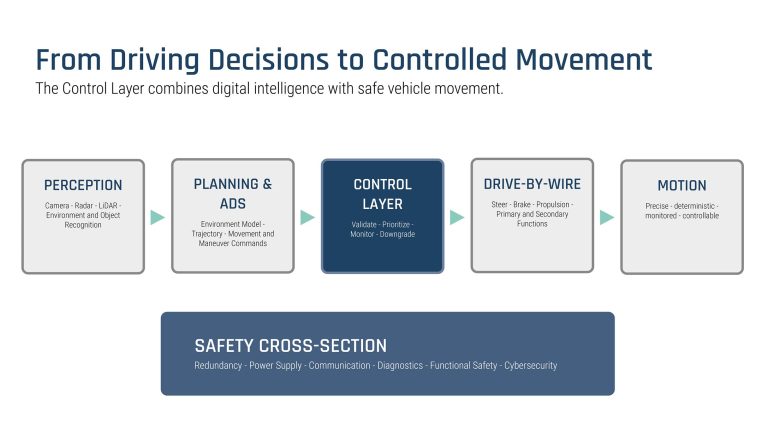
Digital driving decisions must be translated into steering, braking and propulsion commands, validated, prioritized, monitored and, in the event of a fault, safely degraded.

Arnold NextG describes this safety-critical level as the Control Layer. The term is not a regulatory requirement but rather an architectural classification.

The Control Layer connects the decision-making logic with the actuators and creates a defined, verifiable interface between software and physical systems. It must function independently of whether a driving command originates from an ADS, a teleoperation control center or driver interaction.

Safety-by-Wire as the Control Layer

With NX NextMotion, Arnold NextG is developing a modular, vehicle-platform-independent and multi-redundant control platform for drive-by-wire. The quadruply redundant hardware and software architecture is designed to control primary functions such as steering, braking and propulsion, as well as selected safety-critical secondary functions, on a common system basis and to maintain operation in the event of defined single faults.

According to the company and the TÜV certifications provided, the safety concept is aligned with functional safety standards ISO 26262 up to ASIL D and IEC 61508 SIL 3. Arnold NextG also provides TÜV certifications for steering and braking systems in accordance with UN ECE R79 and R13, as well as road approval for NX NextMotion autonomous, teleoperated and software-defined vehicle projects.

Regulatory requirements become part of the operating model

At the 21st session of the UNECE Working Group on Automated Driving Systems (ADS), work continued on the Guidance and Interpretation Documents (GID) for UN R185 and UN GTR No. 26. The session emphasized that the new ADS regulations are accompanied by technical guidelines and interpretive aids and that their practical application is being gradually refined.

From Arnold NextG’s perspective, this development underscores that requirements for the safe implementation, monitoring and verification of automated driving functions must be considered across the entire vehicle lifecycle. It reinforces the company’s view that regulatory requirements should be considered from the outset of vehicle development rather than addressed after technical work is complete. This includes integrating requirements for verification, diagnostics, data management, software updates and operational monitoring into the system architecture and the product lifecycle.

In related news, Curiosity Lab launches program to support growth-stage AV companies

Share. Twitter LinkedIn Facebook Email
Previous ArticleYokogawa launches high-voltage power analyzer for EV testing
Next Article Emerson enhances Nigel AI to deliver improved test productivity
Zahra Awan

Zahra brings her background in reporting on the heavy manufacturing industry together with her passion for automotive as web editor at UKi Media & Events. She is keen to connect with people across the sector who share her enthusiasm for automotive innovation.

Related Posts

The The NI PXIe-1480 carrier module pictured in profile against a white background.
Test equipment

Emerson launches NI-powered modular testing architecture for display and camera systems

July 21, 20262 Mins Read
Beamr partners with Intempora to bring ML-safe video data to RTMaps.
Data Storage

Beamr partners with Intempora to bring ML-safe video data to RTMaps

July 15, 20263 Mins Read
A schematic diagram of a car against a dark blue background with a grid.
ADAS & CAVs

Curiosity Lab launches program to support growth-stage AV companies

July 8, 20262 Mins Read
Latest News
A male engineer looks at NI Nigel AI displayed on two adjacent screens in a laboratory office environment.

Emerson enhances Nigel AI to deliver improved test productivity

July 28, 2026
Arnold NextG aligns Safety-by-Wire with UNECE ADS rules.

Arnold NextG aligns Safety-by-Wire with UNECE ADS rules

July 28, 2026
Yokogawa WT1500 High-Precision Power Analyzer.

Yokogawa launches high-voltage power analyzer for EV testing

July 28, 2026
Free Weekly E-Newsletter

Receive breaking stories and features in your inbox each week, for free


Enter your email address:


Our Social Channels
  • LinkedIn
Getting in Touch
  • Free Weekly E-Newsletter
  • Meet the Editors
  • Contact Us
  • Media Pack
RELATED UKI TITLES
  • Automotive Interiors
  • Automotive Powertrain
  • ADAS & Autonomous Vehicle
  • Professional Motorsport
  • Tire Technology
  • Media Pack
© 2025 UKi Media & Events a division of UKIP Media & Events Ltd
  • Terms and Conditions
  • Privacy Policy
  • Cookie Policy
  • Notice & Takedown Policy
  • Site FAQs

Type above and press Enter to search. Press Esc to cancel.

We use cookies on our website to give you the most relevant experience by remembering your preferences and repeat visits. By clicking “Accept”, you consent to the use of ALL the cookies.
Cookie settingsACCEPT
Manage consent

Privacy Overview

This website uses cookies to improve your experience while you navigate through the website. Out of these, the cookies that are categorized as necessary are stored on your browser as they are essential for the working of basic functionalities of the website. We also use third-party cookies that help us analyze and understand how you use this website. These cookies will be stored in your browser only with your consent. You also have the option to opt-out of these cookies. But opting out of some of these cookies may affect your browsing experience.
Necessary
Always Enabled
Necessary cookies are absolutely essential for the website to function properly. These cookies ensure basic functionalities and security features of the website, anonymously.
CookieDurationDescription
cookielawinfo-checbox-analytics11 monthsThis cookie is set by GDPR Cookie Consent plugin. The cookie is used to store the user consent for the cookies in the category "Analytics".
cookielawinfo-checbox-functional11 monthsThe cookie is set by GDPR cookie consent to record the user consent for the cookies in the category "Functional".
cookielawinfo-checbox-others11 monthsThis cookie is set by GDPR Cookie Consent plugin. The cookie is used to store the user consent for the cookies in the category "Other.
cookielawinfo-checkbox-necessary11 monthsThis cookie is set by GDPR Cookie Consent plugin. The cookies is used to store the user consent for the cookies in the category "Necessary".
cookielawinfo-checkbox-performance11 monthsThis cookie is set by GDPR Cookie Consent plugin. The cookie is used to store the user consent for the cookies in the category "Performance".
viewed_cookie_policy11 monthsThe cookie is set by the GDPR Cookie Consent plugin and is used to store whether or not user has consented to the use of cookies. It does not store any personal data.
SAVE & ACCEPT