

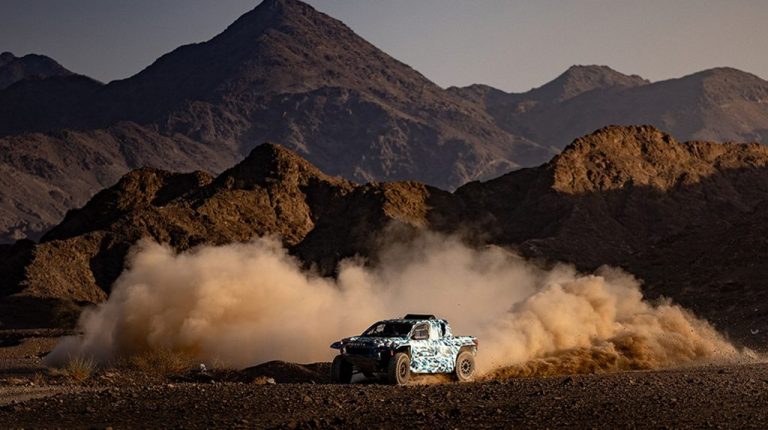
Gazoo Racing will enter the DKR GR FC Hilux, a fuel cell electric vehicle (FCEV), in the 2027 Dakar Rally.
The project represents a new challenge to demonstrate hydrogen fuel cell technology in the demanding conditions of the Dakar Rally. Based on the DKR GR Hilux, the DKR GR FC Hilux replaces its gasoline engine with Toyota’s fuel cell system. It emits no CO2 while driving, with water as its only tailpipe emission.
The Dakar Rally’s high temperatures, rough terrain and long stages make it a demanding test environment for hydrogen fuel cell technology. Toyota said that the project will focus on fuel cell downsizing, cooling performance, durability and energy management.
Lessons learned from developing and operating the DKR GR FC Hilux will contribute to the wider application of fuel cell technology in passenger cars, trucks, buses, trains, marine applications, race cars and stationary power generators. Engineers involved in the project also hope to develop problem-solving skills through hands-on, on-site experience.
Testing and tuning of the FCEV powertrain and its software, together with vehicle build-up, have begun in Belgium. A test program will be conducted progressively in the coming months.
The Dakar Rally will be held in Saudi Arabia from January 1 to January 15, 2027, with King Abdullah Economic City serving as the starting and finishing point.
The DKR GR FC Hilux will compete in the Dakar Future Mission 1000 category, which is dedicated to experimental vehicles and the demonstration of new technologies. The category follows a unique competitive format, with crews of drivers and navigators racing against the clock over 13 stages comprising a total of 1,000 competitive kilometers.
Hydrogen in motorsports
Toyota’s efforts to use hydrogen-related technologies in motorsports began in 2021, when Rookie Racing entered the Japanese Super Taikyu series with the hydrogen-engined ORC Rookie Corolla H2 Concept.
In rallying, the potential of hydrogen engines was demonstrated in 2022, when the GR Yaris H2 completed demonstration runs at the Ypres Rally in Belgium, a round of the FIA World Rally Championship. Further development was showcased through demonstration runs by the GR Yaris Rally2 H2 Concept at Rally Finland in 2025 and Rallye Monte-Carlo in 2026.
In the 2024 Dakar Rally, HySE-X1, a hydrogen-engine buggy, completed the Dakar Future Mission 1000, followed in 2025 by the evolved HySE-X2. Both vehicles were entered by HySE (Hydrogen Small mobility & Engine technology Association), a technical research association in which Toyota Motor Corporation participates.
In circuit racing, the 2026 24 Hours of Le Mans – a round of the FIA World Endurance Championship – featured demonstration laps by the TR LH2 Racing Prototype, which is powered by a liquid-hydrogen engine and based on the TR010 Hybrid race car. In addition, a hydrogen-engined GR Corolla equipped with superconducting technology became the first vehicle of its kind in the world to complete a race in the 2026 Super Taikyu series.
The 2027 Dakar Future Mission 1000 will be the first time Toyota has combined hydrogen and fuel cell technology in its motorsport activities.
In recent news, ORECA selects Siemens’ Simcenter to support motorsport development programs