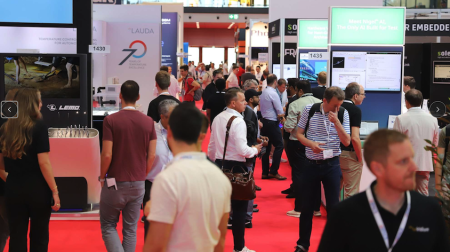


The inaugural Vehicle Tech Week Europe, held at Messe Stuttgart on June 23-24, 2026, saw the launch of several new initiatives to encourage peer-to-peer discussion. Among them was a program of VIP Executive Club Roundtables, hosted in the VIP Lounge in the Hall 1 Gallery. These 90-minute sessions enabled senior professionals from OEMs and Tier 1 suppliers to exchange insights across sectors and disciplines.
On June 24, Vehicle Tech Week association partner ASAM hosted the ‘Standardization in the age of AI’ roundtable attended by representatives from passenger and commercial vehicle manufacturers, suppliers, software companies and autonomous-driving firms to discuss a challenge facing every industry: the impact of AI.
Senior professionals from Avatr, Bosch, Valeo, Cariad, Volvo, ZF, Nissan, Iveco, Bugatti Rimac, Mercedes-Benz, Chery Europe, ADASTec, Forvia and CLAAS and more – with roles ranging from UX designer, software architect and NVH engineer to buyer, global testing director and AD/ADAS performance test manager – explored how AI is reshaping the role of standards across the automotive ecosystem. Discussions focused on where standardization is breaking down, AI’s impact on interoperability, industry collaboration versus competitive advantage, the role of organizations such as ASAM and AUTOSAR, and how innovation can be aligned with shared frameworks.
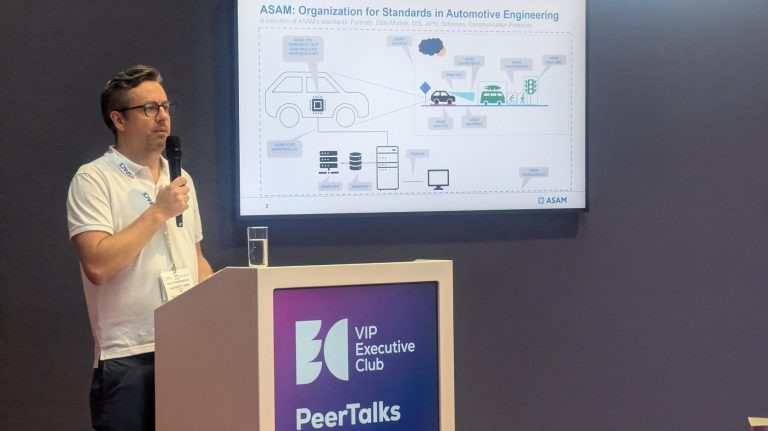
As a specialist in standardization for automation and measuring systems, ASAM examined where AI and standardization meet, namely:
- Consumption layer – chat tools, agents, notebooks and dashboards where intent becomes a question.
- Interface layer – formats, APIs, query languages, and the contract a tool docks against.
- Data layer – the governed substrate: files, databases, catalogs, etc.
Facilitated by Dr Ralf Nörenberg, member of the board of directors at ASAM, the discussion opened with the observation that AI systems operate with varying levels of autonomy and can generate predictions, recommendations, decisions and content. While definitions broadly agree on these characteristics, uncertainty remains over which systems fall under the scope of AI.
“The business has changed, and structure is no longer a given,” said Nörenberg. “What changes is how we interact with data; what never changes is the need for the data to mean something. But the question is not standards or AI; it is which regime the task is in, and whether the access layer stays standardized enough for AI to reach the data at all.”
Participants split into two groups to discuss their current and future use of LLMs, skills development, process changes and model training, while identifying the most important developments to monitor.
Findings
Vishnu Vardhanan Asvatha Narayanan, function owner – system engineer at Valeo, led the first group.
“We discussed the standardization of the vehicle, which is very much needed,” said Narayanan. “AI requires consolidated input data and standardized output data across suppliers. Once both are standardized, AI can be used more effectively. However, expertise is still needed to verify and validate the results.”
The group highlighted the importance of clear contracts between layers and pipelines, warning that without them, systems can fail regardless of the quality of the output. Traceability between inputs and outputs was also identified as critical for effective AI deployment.
The second discussion was led by Markus Bachmaier, deputy general manager at Mitsubishi Electric Automotive Europe.
“Our conclusions were similar,” he said. “Standardized rules for AI agents could be beneficial across different use cases, particularly where large data layers are involved. Different users may require different views of the same data, but standardized approaches could make information more accessible and consistent.”
The group also explored the role of standards in reducing liability and whether organizations such as ASAM could provide automated validation environments to offer reliable and liable results. However, participants acknowledged the challenge of standardizing outputs from large language models, which can vary depending on when, how and by whom questions are asked, especially considering LLMs adjust themselves to the history of each author of spoken questions.
Looking ahead
Vehicle Tech Week Europe will return to Stuttgart on June 2-3, 2027, comprising Automotive Testing Expo; the new Advanced Chassis & Powertrain Showcase; and the evolution of Autonomous Vehicle Tech Expo into Intelligent Vehicle Expo and Automotive Interiors Expo into Automotive Design & In-Cabin Expo.
Read more about Vehicle Tech Week Europe.
Read more about Automotive Testing Expo Europe 2026.
For further information, contact Charlotte Sanchez Iggulden (charlotte.Iggulden@ukimediaevents.com)
For details on ASAM’s standards, please visit their website.