

The 2026 HBK Smart Prototypes Summit (HBK SPS) took place in Udine, Italy, on May 19-22, with a focus on the integration of virtual and physical testing and on how to extract meaningful insights from data – which the supplier also discusses in detail in the upcoming June edition of ATTI.
“It was a great start yesterday (May 19) with the launch of our smart prototyping concept with lots of positive feedback from customers and partners,” said Tanneke Reinders, executive VP at HBK. “From this morning’s presentations we really see ‘smart testing’ coming alive. The key is transforming from data creators to data interpreters – that’s the main shift for us. It’s about connecting data in one ecosystem. When we talk about data, especially the amount of data and fragmentation of it, we want to support.”
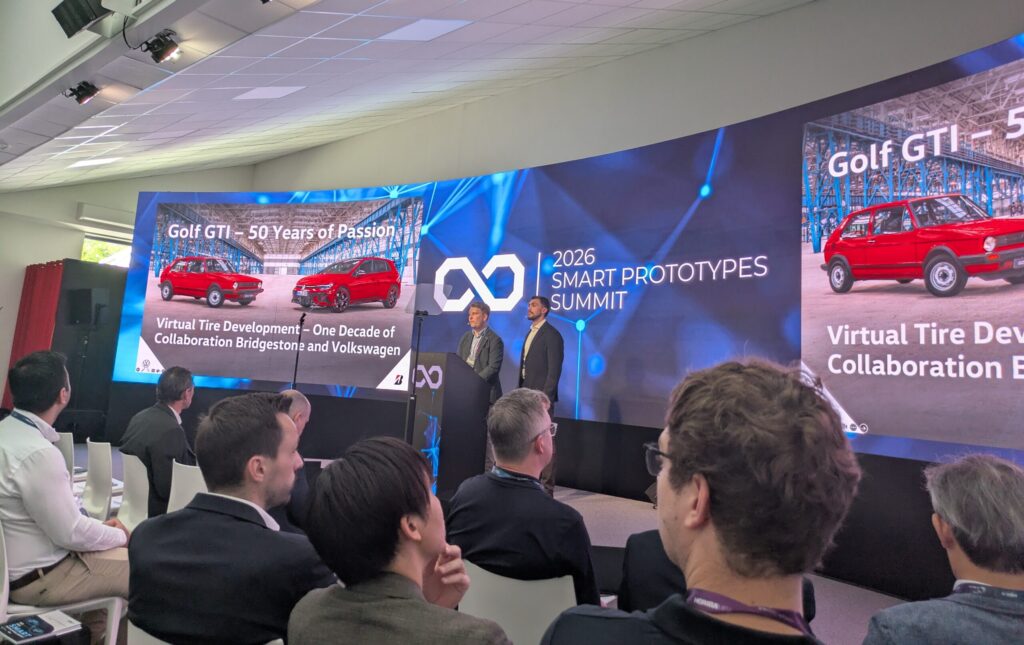
This year there were multiple tire-focused presentations, highlighting the critical role of the tire and its relationship with the vehicle. It seems tire and vehicle developers are working closer together than ever to refine their use of simulation and tighten the integration between the digital and real worlds. This was exemplified in the opening presentation by Alessandro Capobianco, R&D specialist for tire models and vehicle/DIL simulation at Bridgestone, and Eric Walter, vehicle dynamics CAE engineer at VW (both above), who provided an insight into their vehicle/tire co-development work.
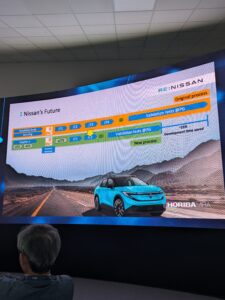
Another of ATTI’s highlights from the summit was the Nissan and Horiba Mira presentation (right), in which the two speakers, Leo May, lead simulation engineer, Nissan Motor Corp, and Stratos Stratoudakis, a consultant at Horiba Mira, detailed how they are working together to prioritize virtual development by moving it further forward in the cycle, with the ultimate aim of reducing development time by 25%.
Marc Hedrich, a development engineer at event exhibitor Team Rosberg Engineering, said of the company’s attendance at the summit: “We are presenting our expertise in providing simulation models. The focus for us is to learn new things because software is ever evolving and you don’t want to be left behind. I like this year’s approach of trying to get the best data and not the most. I’ve learned already how others such as Mercedes-AMG are using these tools. It’s cool to connect with companies that are doing similar things and others that are doing things we’ve never heard of.”
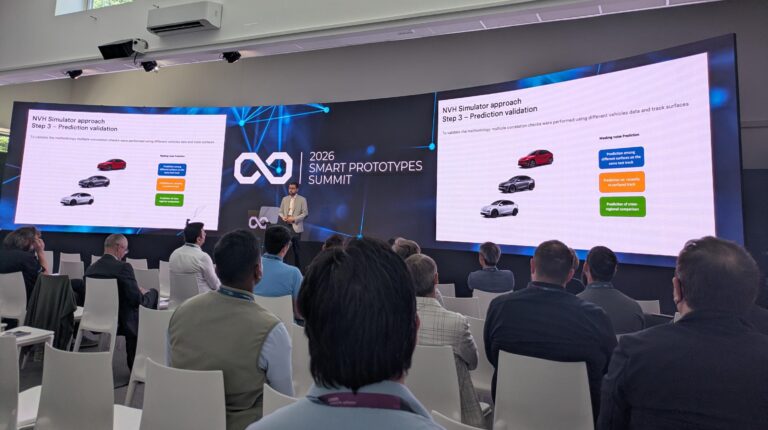
This morning concluded with a presentation from the rarely heard-from Tesla (top), which gave insights into the company’s NVH analysis using a simulator.
Francesco Calabrese, who was attending as an exhibitor representing Fraunhofer ITWM as well as the institute’s spin-off, Virtual Tire Technologies, said, “It’s a good event to push the word for using more simulation with the goal of spending less money on prototypes. What I like is the excitement in this field as it grows – every year there are significantly more people which is a sign people are understanding the importance of it.”
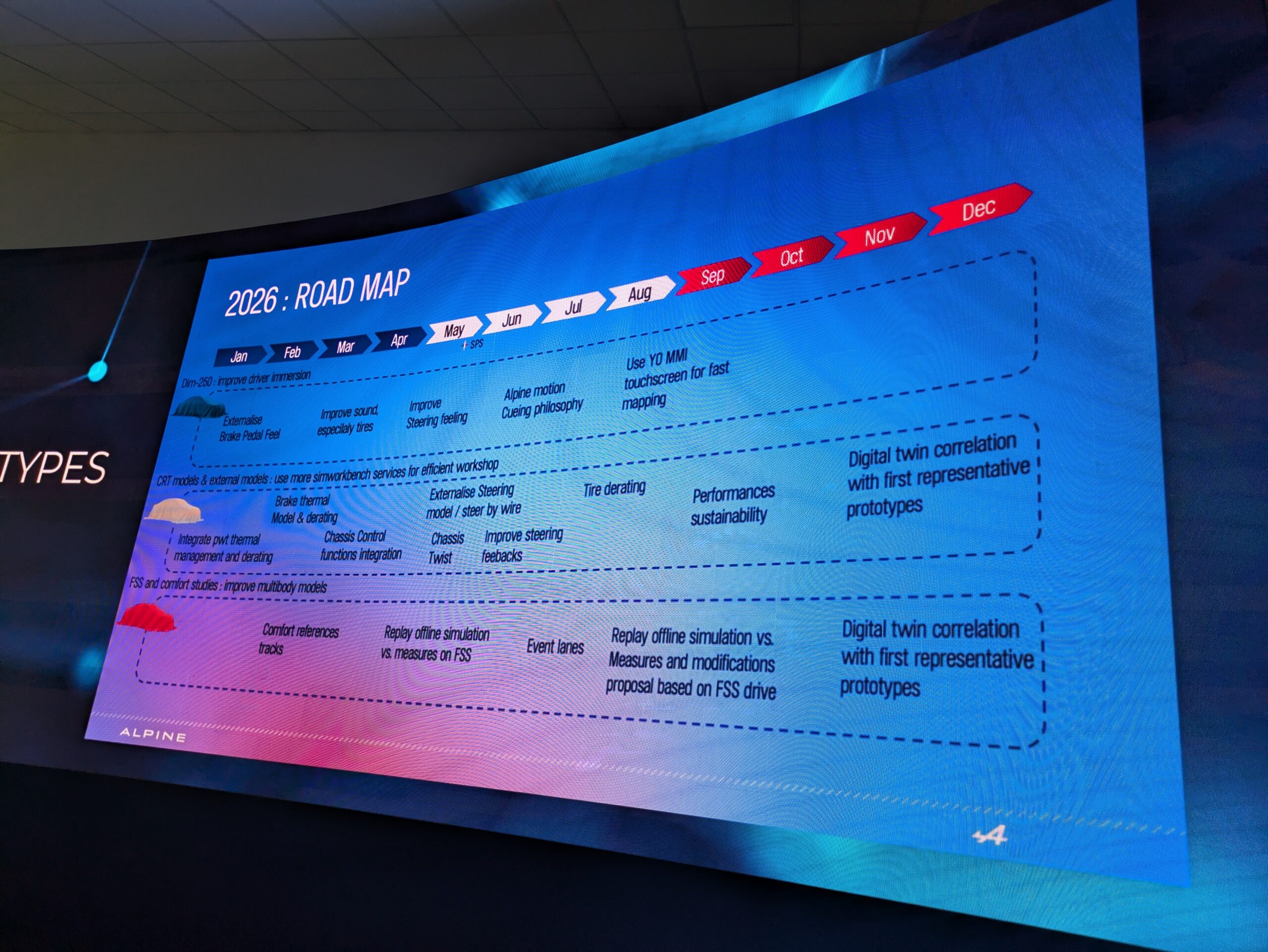
Another OEM getting to grips with driver-in-the-loop simulation was Alpine. Rémi Auman, expert leader in simulation for ride and handling, noted that his team is targeting three areas for 2026 (see image below): enhancing driver immersion – an ongoing challenge for all developers; increasing the use of sim-workbench services; and improving multibody models. For comfort studies, Auman stated that the auto maker’s models are quite mature, so the next steps will be to adjust the settings and, “maybe in the future, we’ll be able to achieve real-time simulation,” he said.
With the conference’s emphasis on data harnessing, Cosin Scientific Software, which has been a partner of VI-grade for more than 15 years, launched its fresh approach to tire data management. With an increasing amount of users, the company has run into scaling problems when distributing high-quality input data. Developing countries especially cannot afford high-quality input data. To address this, the company has created a marketplace with a digital rights management system where tire data providers can market their data through Cosin’s software on the platform.
Cosin MD Gerald Hofmann explained, “Up until now, tire data has been sold as data files. This means once the data is out your hands, then it’s out in the wild. You can’t build a business model on this, which is why this data is very expensive. By putting the data under a digital rights management scheme, then the data provider can sell it using pay-per-use models.”
According to Hofmann, the development of this tire data library was an unexpected but welcome development for visitors: “We are very excited to see how this will be adopted through workflows which are currently very static. We’re hoping to break this up by giving access to a variety of input data. Users can allocate budget for a library of tires to choose from during the development cycle.”
AI specialist JuliaHub exhibited its latest technology, Dyad 3.0, which combines scientific machine learning with Gen AI. According to JuliaHub head of business development Europe Michael Hoffman, its name comes from its dual capabilities in performing controls and system modeling.
Asked what the company’s USP is, Hoffmann emphasized that having a single AI agent that can replace multiple tools is a powerful offering: “When we started Dyad we had AI mind – it wasn’t an afterthought where we had to do a plug-in. This means that the agent knows our architecture, and it only has to deal with one language.”
As expected, Dyad was met with both excitement and skepticism at the HBK SPS.
“We feel when talking about smart testing, we can add value,” added Hoffmann. “You have the measurements and we have the people to get the mathematical models or to refine their simulation models. For example, our value proposition to Rebel Dynamics [a servo platform partner of VI-grade], is that they have a mathematical model of their system, but they also have measurements, and there are differences between the two. We could help them minimize those differences so they can achieve better control.”
Related news, rFpro develops Japanese test route digital twin for virtual vehicle development