

Integrals Power‘s lithium manganese iron phosphate (LMFP) cathode active materials have proved both durability and performance in long-term cycling and extreme low temperature testing conducted by QinetiQ.
The ongoing test program has achieved more than 1,500 charge and discharge cycles at a 1C rate, with the pouch cell retaining nearly 80% of its original capacity. The 1,000-cycle milestone was passed last year, at which point the retained capacity was more than 80%. Durability is critical for lithium-ion battery packs in applications requiring long service life with minimal degradation, such as electric vehicles.
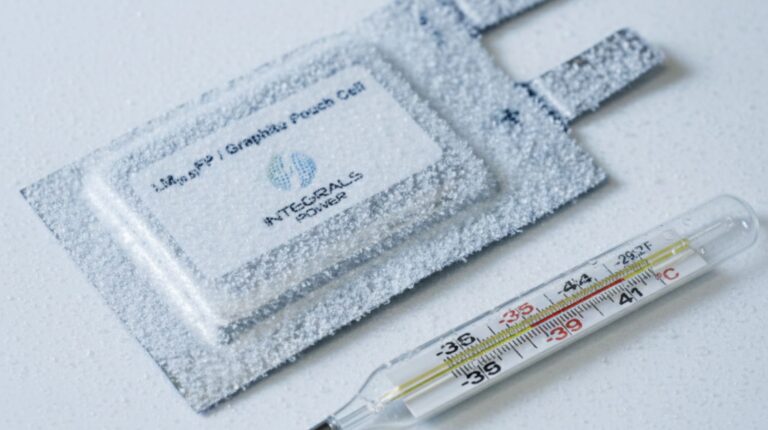
Sub-zero testing by Cranfield University evaluated the pouch cell’s ability to retain high capacity in extremely low temperatures. The tested cell, from the same batch as those evaluated by QinetiQ, retained 85% of capacity at -25ºC and 68% at -30ºC. In comparison, benchmark LFP and LMFP chemistries typically retain around 50% and 40%, respectively.
In addition to durability and performance, Integrals Power’s LMFP material offers lower cost, improved safety, reduced toxicity, less reliance on critical minerals and a smaller carbon footprint compared with nickel manganese cobalt (NMC) chemistries commonly used in EV batteries. It also provides higher energy density than LFP.
Integrals Power founder and CEO Behnam Hormozi said, “Independent, third-party testing by industry experts is a cornerstone of our business, and these latest results from QinetiQ and the University of Cranfield are invaluable in providing trusted and credible data to our customers around the world.
“The results prove that batteries made from our LMFP material can last longer, and perform better in sub-zero conditions. Overcoming the compromises and limitations imposed by existing cell chemistries is essential if battery power is to realize its full potential across a range of sectors, and we’re showing that it can do exactly that.”
Related news, Changan and CATL launch world’s first mass-production sodium-ion EV